The global race to dominate artificial intelligence is no longer limited to chips and software. It is now expanding into robotics, smart factories, and next-generation data centers. That shift became even more evident on Monday after Nvidia CEO Jensen Huang revealed that the company is deepening its partnership with South Korea’s LG Group on several future-focused technologies, including humanoid robots.
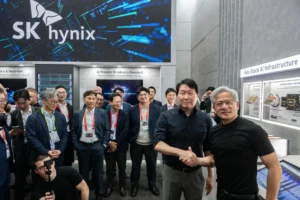
The announcement came during Huang’s visit to Seoul, where he met with LG Group Chairman Koo Kwang-mo. While Nvidia has become the face of the AI boom thanks to its powerful processors, the company is increasingly positioning itself at the center of broader technological ecosystems that combine AI hardware, robotics, automation, and infrastructure.
Nvidia Sees Humanoid Robots as the Next Big Opportunity
Speaking to reporters after the meeting, Huang confirmed that Nvidia and LG are working together on technologies that could help accelerate the development of humanoid robots. The collaboration reportedly includes motor technology, mechanical systems, and other core components needed to build advanced robotic platforms.
The partnership reflects a growing belief among major technology companies that humanoid robots could become one of the next major growth sectors after generative AI. Over the past year, companies around the world have invested heavily in machines capable of performing physical tasks in factories, warehouses, hospitals, and even homes.
Nvidia has already established itself as a key player in robotics through its AI platforms and simulation technologies. By combining those capabilities with LG’s expertise in electronics, manufacturing, and engineering, both companies appear to be positioning themselves for a future where intelligent machines play a much larger role in daily life.
Industry analysts have increasingly pointed to labor shortages, aging populations, and rising automation demands as factors driving interest in humanoid robotics. South Korea, which already ranks among the world’s most technologically advanced economies, has been particularly active in supporting robotics innovation across multiple sectors.
Data Centers Become Another Major Focus
The collaboration is not limited to robots. Huang also revealed that Nvidia and LG are working together on designing future data centers, an area that has become critically important as AI workloads continue to explode worldwide.
Modern AI systems require enormous computing resources, forcing technology companies to build larger and more efficient data centers. These facilities are now considered strategic assets because they power everything from cloud computing services to advanced AI models and enterprise applications.
As demand for AI infrastructure continues rising, companies are racing to secure access to high-performance chips, advanced cooling systems, and energy-efficient architectures. Nvidia’s processors remain the industry standard for training and running many of today’s leading AI models, giving the company significant influence over how next-generation data centers are built.
For LG, the partnership offers an opportunity to strengthen its presence in the rapidly growing AI infrastructure market. The South Korean conglomerate has already expanded beyond consumer electronics into areas such as batteries, energy solutions, and industrial technologies. Working alongside Nvidia could help the company capture a larger share of the AI economy as businesses increase spending on computing infrastructure.
A Growing AI Alliance Between Global Tech Giants
The announcement highlights how quickly AI partnerships are evolving beyond traditional software projects. Technology companies are increasingly seeking collaborations that combine hardware, manufacturing expertise, and artificial intelligence into integrated ecosystems.
Nvidia has spent the last two years transforming from a graphics-chip company into one of the most influential forces in the AI industry. Its market value has surged as demand for AI processors continues to break records, while governments and corporations worldwide invest billions into new AI capabilities.
The partnership with LG suggests Nvidia is looking beyond chips alone and toward technologies that could define the next decade. Whether through humanoid robots capable of assisting humans in physical environments or massive AI-powered data centers supporting future applications, both companies appear to be preparing for a world where artificial intelligence extends far beyond the screen.