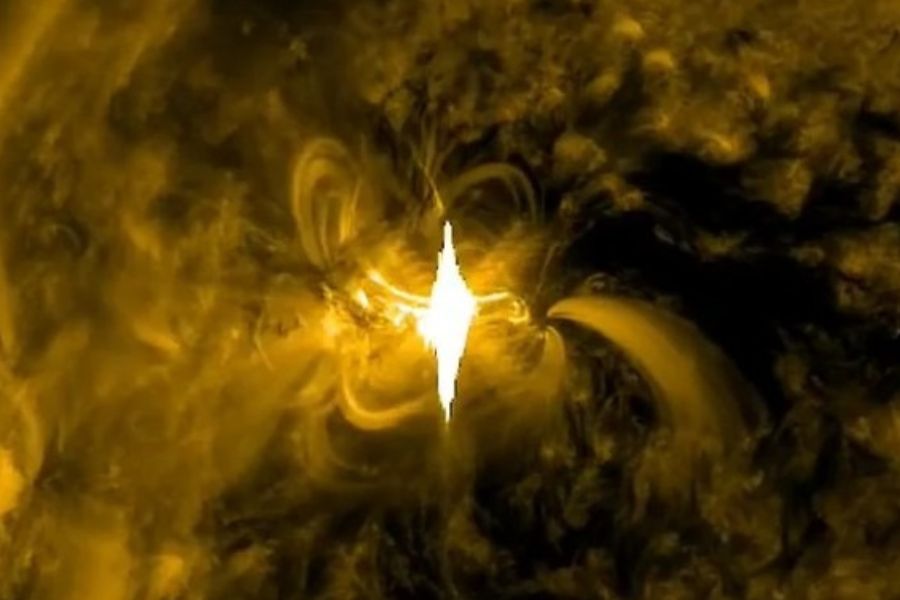
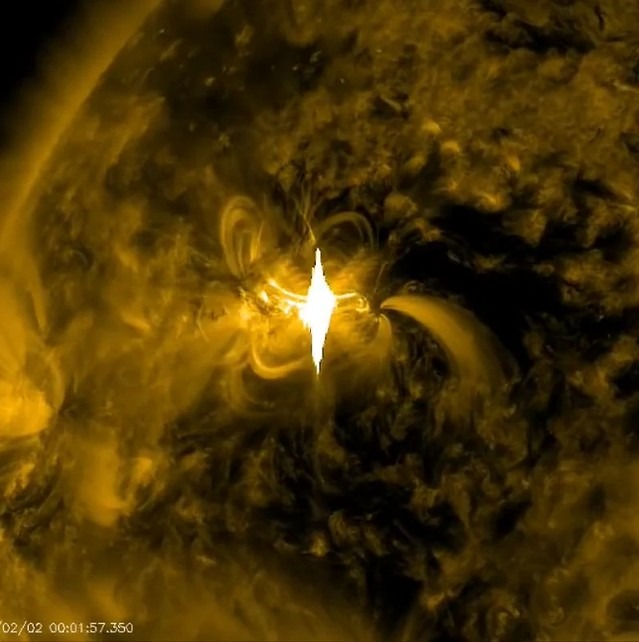
The Sun is unusually restless right now — and scientists are watching closely. A rapidly growing sunspot known as AR4366 has erupted with an extraordinary burst of solar activity, earning it the nickname “solar flare factory.” In just 24 hours, the region unleashed the strongest solar storm of 2026 so far, and it’s now rotating into direct view of Earth.
A Rare Surge in Solar Fury
Between February 1 and 2, AR4366 released a staggering number of eruptions:
- 23 M-class flares (mid-level but still powerful)
- 4 X-class flares, the most intense category
- One massive X8-class flare, the strongest recorded this year
To put that in perspective, X-class flares are roughly ten times stronger than M-class flares, and an X8 sits dangerously high on that scale.
Scientists tracking the Sun say AR4366 is enormous — estimated to be about half the size of the historic 1859 Carrington Event sunspot, the storm that once disrupted telegraph systems across the world.
Experts at NOAA say the region remains magnetically unstable and continues to generate strong flares, warning that more eruptions are likely in the coming days.
Why Scientists Are Especially Concerned
The concern isn’t just the intensity — it’s the timing. AR4366 is now turning to face Earth directly, increasing the chances that future flares or plasma bursts could be Earth-directed.
According to NASA, the Sun is currently in solar maximum, the peak phase of its 11-year cycle. During this period, sunspots grow larger, magnetic fields become unstable, and violent solar storms become more common — a trend expected to continue through 2026.
Spaceweather analysts say AR4366’s complex magnetic structure makes it particularly unpredictable.
Early Impacts Already Felt on Earth
The powerful X8 flare on February 1 has already made its presence known. It triggered a strong radio blackout across parts of the South Pacific, temporarily disrupting shortwave radio communications in eastern Australia and New Zealand.
Events of this magnitude can also:
- Interfere with GPS and satellite navigation
- Disrupt aviation and maritime communications
- Damage sensitive satellite electronics in orbit
What Could Happen Next
Forecasters are now tracking a coronal mass ejection (CME) associated with AR4366 — a massive cloud of charged solar particles launched into space. Current projections suggest a possible glancing impact with Earth around February 5.
If the CME connects with Earth’s magnetic field, the effects could include:
- Brilliant auroras visible much farther from the poles
- Temporary geomagnetic disturbances
- Minor satellite and communication disruptions
Final Words
AR4366 has already cemented itself as the most dangerous sunspot of 2026 — and it may not be done yet. As it fully rotates toward Earth, scientists are on high alert for further eruptions that could test modern technology in space and on the ground.
For now, it’s a powerful reminder that even from 150 million kilometers away, the Sun can still shake our planet — and we’re entering the most volatile phase of its cycle.