For centuries, humanity believed Earth might be unique — a rare oasis in a vast, empty universe. Even when astronomers began discovering exoplanets in the 1990s, most of them were strange giants hugging their stars, nothing like our rocky home.
Then came a revelation that quietly reshaped astronomy: the galaxy seems to prefer making Super-Earths — and our solar system doesn’t have a single one.
The Discovery That Changed Planetary Science
The turning point arrived in 2004 with the discovery of Gliese 876d, a planet roughly seven times the mass of Earth orbiting the red dwarf star Gliese 876.
It wasn’t a gas giant. It wasn’t a small rocky world either. It fell somewhere in between — giving birth to a new planetary category astronomers began calling Super-Earths.
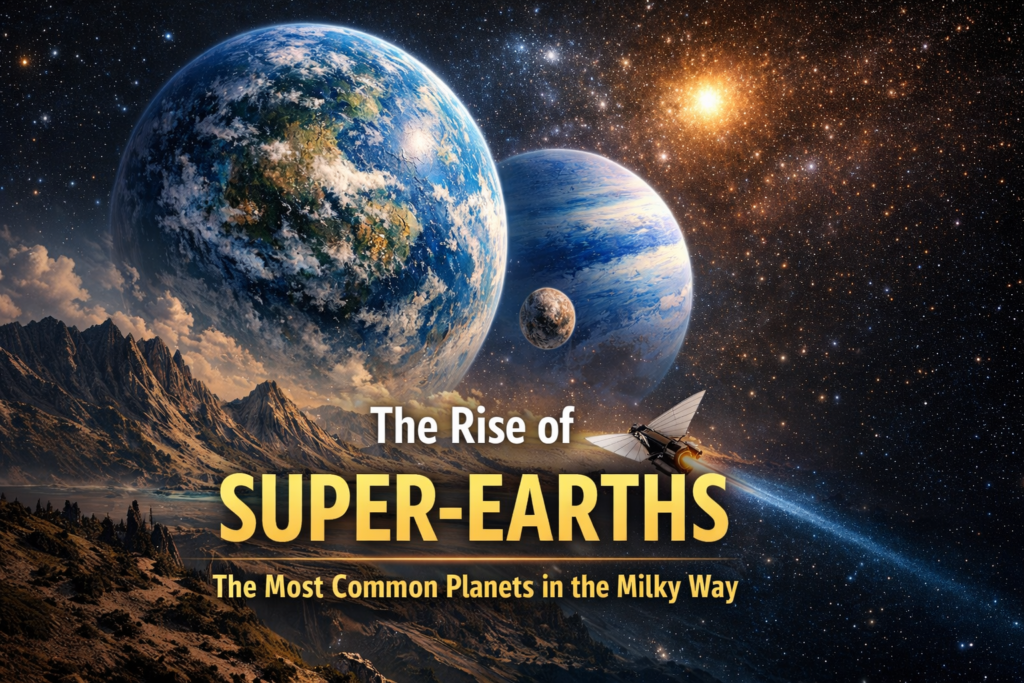
Despite the dramatic name, Super-Earths are not necessarily better versions of Earth. The term refers only to their size and mass — typically between two and ten times Earth’s mass. Over time, researchers realized these worlds aren’t rare anomalies. They may actually be the most common type of planet in the Milky Way.
Ironically, our own cosmic neighborhood contains none.
Kepler’s Game-Changing Flood of Data
If Gliese 876d opened the door, the launch of the Kepler Space Telescope in 2009 blew it wide open.
Kepler monitored more than 150,000 stars, searching for tiny dips in brightness caused by planets passing in front of them. The results were staggering. A large fraction of detected planets fell into the Super-Earth size range.
By 2013, NASA scientists concluded that small planets — especially Super-Earths — are among the most common worlds in our galaxy. That finding forced scientists to rethink planetary formation theories. If nature favors making these mid-sized planets, why doesn’t our solar system have one?
What Are Super-Earths Actually Like?
Super-Earths are not a single type of world. They come in many flavors:
- Rocky giants — scaled-up versions of Earth
- Water worlds — possibly covered by deep global oceans
- Mini-Neptunes — with thick hydrogen and helium atmospheres
Gravity on such a planet would feel intense. A person might weigh two or three times more than on Earth. Mountains could appear lower and flatter, compressed by stronger gravity. Atmospheres could be denser and heavier.
Some Super-Earths orbit extremely close to their stars, with surfaces hot enough to melt rock. Others exist in the habitable zone, where liquid water could potentially survive.
That range makes them particularly fascinating for scientists searching for life.
The Planet That Captured Global Imagination
In 2015, NASA announced the discovery of Kepler-452b, a Super-Earth orbiting a Sun-like star in the habitable zone. It quickly became one of the most talked-about exoplanets ever found.
Though it lies about 1,400 light-years away, Kepler-452b challenged the idea that Earth-like conditions are rare cosmic accidents. If one such world exists, there could be billions more.
A Neighboring Super-Earth Next Door
Even more thrilling was the 2016 discovery of Proxima Centauri b orbiting Proxima Centauri — the closest star to our Sun.
At just 4.24 light-years away, Proxima Centauri b is practically in our stellar backyard. For the first time, astronomers could point to the nearest star and say: there is likely a rocky world there.
Though current spacecraft would take tens of thousands of years to reach it, concepts like laser-driven light sails could dramatically shorten that travel time in the future.
Why Super-Earths Matter in the Search for Life
Super-Earths may offer ideal conditions for life.
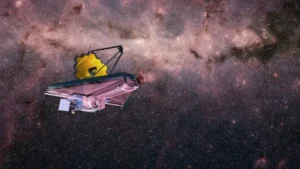
Their stronger gravity helps them retain thick atmospheres — crucial for maintaining stable climates and protecting surface water. Today, the James Webb Space Telescope is analyzing the atmospheres of several Super-Earths, searching for chemical signatures such as water vapor, carbon dioxide, and methane.
If future observations detect biosignatures — gases potentially produced by life — it could transform our understanding of the universe.
A Galaxy Full of Possibilities
The discovery of Super-Earths has rewritten the cosmic narrative.
Once, we assumed our solar system was typical. Now we know it’s just one version of many planetary blueprints.
Billions of Super-Earths likely orbit stars across the Milky Way. Some may be barren volcanic worlds. Others may be ocean-covered giants. A few could resemble Earth in ways we’re only beginning to imagine.
The most striking lesson? The universe doesn’t repeat itself — it experiments.
And somewhere among those countless Super-Earths, there may be skies lit by alien suns, oceans beneath unfamiliar constellations, and landscapes waiting to be understood.
The story of Super-Earths isn’t just about planets. It’s about possibility.