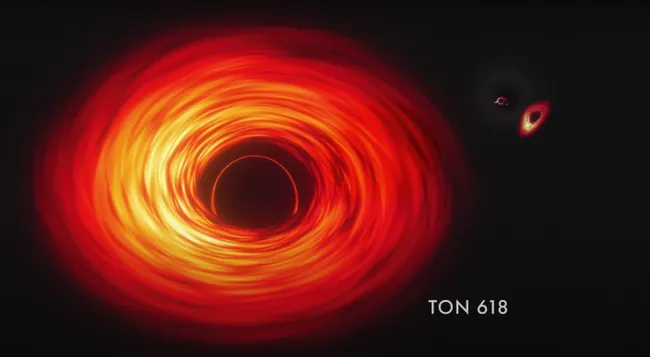
For decades, astronomers have wrestled with a puzzle that never quite added up. Just 200 million years after the Big Bang, the universe already hosted supermassive black holes — cosmic monsters millions, even billions, of times heavier than our Sun. By conventional rules of astronomy, there simply wasn’t enough time for them to grow that big.
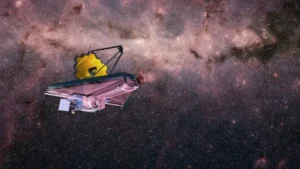
Now, fresh evidence from NASA’s James Webb Space Telescope is offering the clearest explanation yet — and it completely rewrites how the universe’s earliest giants may have been born.
The Problem With “Slow Growth” Black Holes
Traditional theories suggest black holes form from dying stars and slowly gain mass by consuming gas, dust, and nearby stars. But there’s a catch: this process takes billions of years.
Yet astronomers have long observed supermassive black holes existing when the universe itself was still in its infancy. The math didn’t work. Something faster — far more dramatic — had to be happening in the early cosmos.
The Heavy Seed Theory: Skipping Stars Entirely
That’s where the idea of direct collapse black holes comes in.
Astrophysicist Priyamvada Natarajan and her research team proposed a bold alternative years ago: instead of forming from stars, some black holes may have been born directly from collapsing clouds of pristine gas.
In this scenario:
- Massive gas clouds in the early universe collapse under their own gravity
- No stars form first
- The result is a “heavy seed” black hole, already tens of thousands of times the Sun’s mass
Starting big gave these black holes a crucial head start — enough to grow into billion-solar-mass giants in record cosmic time.
For years, it remained a compelling idea with little observational proof. That’s now changed.
Webb Sees Black Holes Where They Shouldn’t Exist
Using data from the JWST, European astronomers have identified multiple ancient galaxies that strongly support the direct-collapse model.
One of the most striking finds is UHZ1, a galaxy observed just 470 million years after the Big Bang, hosting an actively feeding black hole weighing around 10 million solar masses — far too large to be explained by slow growth alone.
Another breakthrough comes from the Infinity Galaxy system, where two colliding galaxies appear to surround a massive black hole embedded in a dense gas reservoir — exactly the conditions predicted for direct-collapse formation.
Together, these observations offer the strongest real-world confirmation yet that heavy black hole seeds truly existed.
Why This Changes Our Understanding of the Early Universe
These discoveries don’t just explain how black holes grew so fast — they reshape our view of how the first cosmic structures formed.
If direct-collapse black holes were common:
- Early galaxies may have evolved around black holes, not the other way around
- The universe’s first billion-solar-mass objects formed far earlier than expected
- Supermassive black holes may be a natural outcome of early cosmic conditions
It’s a reminder that the early universe was far more violent, efficient, and extreme than once imagined.
Final Words
With the James Webb Space Telescope peering deeper into time than ever before, long-standing cosmic mysteries are finally getting answers. The idea that supermassive black holes were born “big,” rather than growing patiently over eons, is no longer speculative — it’s now backed by evidence written in the oldest light we can see.
And as Webb continues to explore the universe’s earliest chapters, this may just be the beginning of a much bigger rewrite of cosmic history.