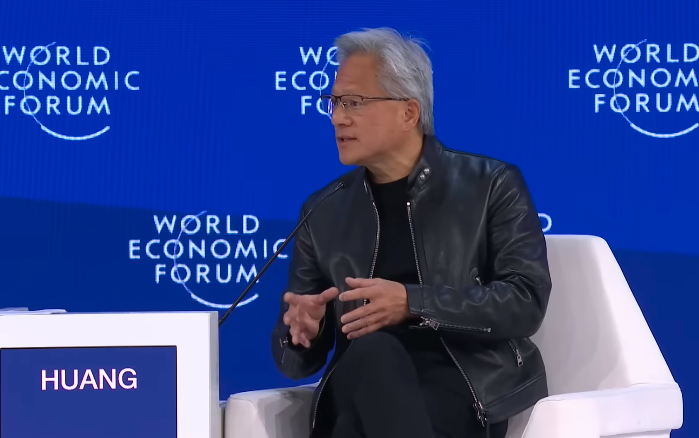
At a time when artificial intelligence is rapidly reshaping industries — and triggering waves of layoffs across tech and corporate sectors — Jensen Huang has delivered one of the strongest rebuttals yet to the growing narrative that AI is replacing jobs.
In a recent interview with CNBC, the Nvidia chief didn’t hold back. Instead of blaming AI for job cuts, Huang turned the spotlight on companies themselves, arguing that layoffs reflect a failure of leadership — not technology.
“You’re Out of Imagination”: Huang’s Sharp Take
When asked why companies are laying off workers while adopting AI to “do more with less,” Huang’s response was blunt.
He suggested that companies cutting jobs are not leveraging AI creatively enough. According to him, organizations with vision would use AI to expand possibilities, not shrink their workforce.
His argument flips a widely discussed concern. Instead of AI being the problem, Huang frames it as a tool — one that depends entirely on how leaders choose to use it.
In his view, when companies default to cost-cutting instead of innovation, it reflects a lack of ideas rather than a limitation of AI itself.
AI Isn’t the Enemy, It’s Just Software
Huang also addressed the broader fear surrounding artificial intelligence — the idea that it is something uncontrollable or inherently threatening.
Speaking on the All-In Podcast, he pushed back against what he called “doomer” narratives.
He emphasized that AI is not a conscious or biological entity. It’s not something mysterious or unknowable. At its core, it’s software — built, trained, and guided by humans.
This perspective is important because much of the public anxiety around AI comes from the belief that it operates beyond human understanding or control.
Huang’s stance is the opposite: AI is a tool, and like any tool, its impact depends on how people use it.
Jobs Will Change — But They Won’t Disappear Entirely
One of the most debated questions around AI is its effect on employment.
Huang didn’t deny that some jobs will be affected. In fact, he acknowledged that certain roles will be eliminated. But he was equally clear that new roles will emerge — potentially in even greater numbers.
His key point is transformation.
Rather than thinking in terms of jobs disappearing, he suggests thinking about how jobs evolve. Tasks may change, workflows may shift, but the underlying purpose of many roles remains intact.
A Real-World Example: Radiology Didn’t Vanish
To explain this, Huang shared an interesting example from the field of medicine.
About a decade ago, a respected computer scientist predicted that advances in computer vision would eliminate the need for radiologists. The logic seemed sound — if AI could read scans more efficiently, why would human specialists be needed?
Today, computer vision is indeed deeply integrated into radiology.
But the outcome wasn’t what many expected.
Instead of declining, the number of radiologists has actually increased. Demand for their expertise has grown.
Why? Because while AI improved the task of analyzing images, it didn’t replace the purpose of the profession — helping doctors diagnose and treat patients.
That distinction, Huang argues, is crucial.
The Bigger Idea: Task vs Purpose
Huang’s argument hinges on a simple but powerful idea — the difference between what people do and why they do it.
Tasks are the specific actions within a job. These can often be automated or improved with AI.
Purpose, however, is the broader role a person plays — solving problems, making decisions, helping others. That part is much harder to replace.
In the case of radiologists, AI made image analysis faster and more accurate, but it also increased the volume of data and the need for human interpretation, oversight, and decision-making.
The result wasn’t job loss — it was job evolution.
Advice for the Next Generation
Huang also had a clear message for young people entering the workforce.
Instead of fearing AI, he urged them to embrace it.
His advice was straightforward: become skilled at using AI tools. Those who understand how to work alongside AI, rather than compete with it, will be in the strongest position.
This reflects a broader shift already happening across industries, where AI literacy is becoming as important as traditional technical skills.
A Divided Industry Perspective
Huang’s comments come at a time when the tech industry itself is divided on AI’s impact.
Some companies are aggressively cutting jobs while investing in automation, framing it as efficiency. Others are experimenting with ways to use AI to augment human capabilities rather than replace them.
Huang clearly belongs to the second camp.
For him, AI is not about reducing headcount — it’s about expanding what people and companies can achieve.
The Real Question Isn’t AI — It’s Leadership
Ultimately, Huang’s criticism is less about technology and more about mindset.
AI, in his view, is a powerful amplifier. It can make good ideas bigger and bad decisions more visible.
If companies use it only to cut costs, they may see short-term gains. But if they use it to innovate, create, and expand, the long-term impact could be far greater.
That’s where “imagination,” as he puts it, becomes the deciding factor.
A Future Still Being Written
As AI continues to evolve, the debate around jobs, automation, and the future of work isn’t going away anytime soon.
But voices like Jensen Huang’s add an important layer to that conversation.
Instead of asking whether AI will replace humans, the better question might be: how will humans choose to use AI?
Because as Huang suggests, the answer may say more about us than it does about the technology.