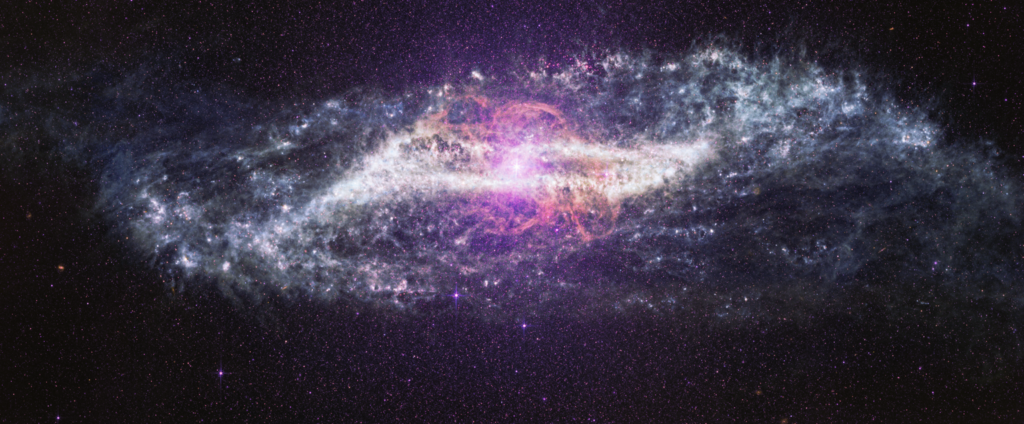
Four years after changing astronomy forever with its first deep-space image, the James Webb Space Telescope (JWST) is once again pushing the boundaries of what humanity can see in the universe. To celebrate the observatory’s fourth anniversary, NASA has unveiled its most detailed infrared images yet of Centaurus A, one of the closest and most intriguing galaxies beyond the Milky Way. The new observations expose structures and stellar activity that previous space telescopes simply could not resolve, offering scientists an unprecedented look inside a galaxy shaped by cosmic violence.
The newly released images highlight why the James Webb Space Telescope has become one of the most important scientific instruments ever built. Equipped with advanced infrared technology, Webb can peer through dense clouds of dust that once hid crucial details from astronomers, revealing regions where stars are born, evolve and eventually die.
James Webb Captures Centaurus A Like Never Before
Located roughly 11 million light-years from Earth, Centaurus A has fascinated astronomers for decades because it behaves very differently from most nearby galaxies. At its heart lies a supermassive black hole that continuously consumes surrounding gas and dust, releasing enormous amounts of energy into space. Scientists believe this active galactic nucleus plays a crucial role in shaping the galaxy’s evolution over billions of years.
Centaurus A also bears the scars of a dramatic collision with another galaxy that occurred around 2 billion years ago. That ancient merger left behind twisted dust lanes and unusual structures that continue influencing star formation today. Because of its relatively close distance and unique history, researchers consider it one of the best natural laboratories for studying how galaxies and black holes evolve together.
NASA said the latest observations celebrate “four years of better-than-anticipated performance and successful science operations for the most powerful space telescope in history.” The new imagery demonstrates just how much Webb has expanded humanity’s ability to observe distant cosmic environments.
Infrared Technology Reveals Hidden Cosmic Structures
Earlier space observatories provided valuable insights into Centaurus A, but each had important limitations. The Hubble Space Telescope captured impressive visible-light images, yet thick dust clouds prevented it from seeing deep into the galaxy’s central regions. Later, NASA’s Spitzer Space Telescope used infrared observations to reveal larger structures, although it lacked the resolution needed to distinguish individual stars.
The James Webb Space Telescope changes that dramatically through its powerful Mid-Infrared Instrument (MIRI). The newly released images reveal intricate dust formations, glowing stellar nurseries and aging stars shedding material back into space with remarkable clarity. Bright reddish-purple regions visible throughout the galaxy indicate areas rich in dust, where new stars are actively forming while older stars recycle material into the surrounding environment.
NASA also released a combined image produced using both MIRI and Webb’s Near-Infrared Camera (NIRCam). By merging data from the two instruments, scientists gain a far more complete picture of Centaurus A, allowing them to examine the galaxy in extraordinary detail across multiple infrared wavelengths.
Why These Images Matter To Astronomy
The latest observations are far more than visually stunning photographs. By identifying and analysing individual stars throughout Centaurus A, astronomers can begin reconstructing the galaxy’s evolutionary history with much greater accuracy than previously possible. Understanding when different generations of stars formed, and how they were influenced by the central black hole, could answer long-standing questions about how massive galaxies grow and transform over cosmic time.
The images also demonstrate the enormous scientific value of infrared astronomy. Unlike visible light, infrared wavelengths can pass through dense interstellar dust, revealing regions that remain hidden to conventional telescopes. This capability allows Webb to study star formation, black hole environments and distant galaxies with unprecedented precision.
Since beginning scientific operations in 2022, the James Webb Space Telescope has repeatedly delivered discoveries that have reshaped astronomers’ understanding of the universe. From identifying some of the earliest known galaxies to analysing the atmospheres of distant exoplanets and now producing its most detailed look at Centaurus A, Webb continues to exceed expectations. Four years after its first iconic image captivated the world, the observatory remains at the forefront of space exploration, offering scientists an increasingly detailed window into the origins and evolution of the cosmos.