Space scientists have uncovered one of the strangest planetary systems ever observed. Using data collected by NASA’s Transiting Exoplanet Survey Satellite (TESS), researchers have identified two enormous planets that are almost as large as Jupiter but astonishingly lightweight. Their densities are so low that scientists compare them to cotton candy, making them among the puffiest planets ever discovered. The unusual finding is giving astronomers a rare opportunity to better understand how giant planets form and evolve far beyond our own Solar System.
The discovery also highlights how much remains unknown about exoplanets orbiting distant stars. While thousands of worlds have now been identified outside our Solar System, only a small number belong to this extremely rare category of ultra-low-density planets. Finding two of them orbiting the same star has surprised researchers and could provide important clues about planetary evolution.
TESS discovers two incredibly lightweight giant planets
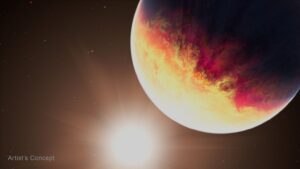
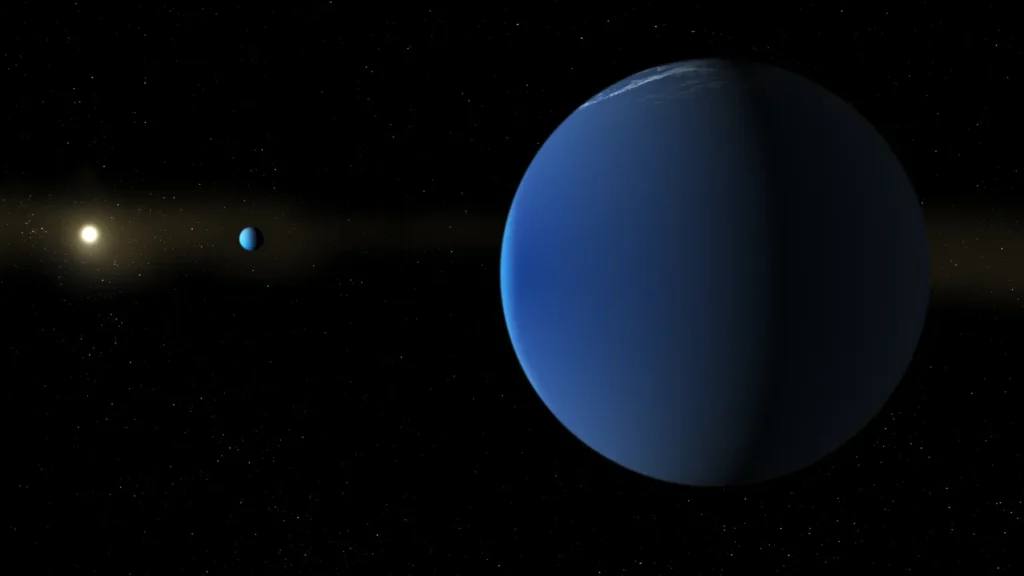
The newly identified worlds have been named TOI-791 b and TOI-791 c. Although TOI-791 b is nearly the same size as Jupiter, it possesses only about three percent of Jupiter’s mass. Its companion, TOI-791 c, is even larger in diameter yet contains only 5.9 percent of Jupiter’s mass, making both planets remarkably inflated compared to the gas giants in our own Solar System. Because so much of their volume is made up of extremely thin gas, scientists say their overall density is comparable to cotton candy.
The research team was led by George Dansfield from the University of Oxford’s Department of Physics after analysing years of observations gathered by TESS. According to the researchers, astronomers have only identified a handful of these so-called “super puffy” planets so far. Discovering two within the same planetary system makes this finding even more unusual and valuable for future research.
NASA scientist Steve Howell explained that studying planets like these could improve scientists’ understanding of how planetary systems develop over billions of years. Current theories suggest the formation of giant planets strongly influences the architecture of an entire star system, making rare discoveries such as TOI-791 b and TOI-791 c particularly important.
Seven years of observations revealed an unusual system
NASA launched the Transiting Exoplanet Survey Satellite (TESS) in 2018 with the goal of finding planets orbiting nearby stars outside our Solar System. Instead of capturing direct images, the spacecraft detects tiny dips in a star’s brightness as planets pass in front of it, a technique known as the transit method. TESS surveys a region of the sky roughly 400 times larger than the area explored during NASA’s earlier Kepler mission, allowing it to discover thousands of new exoplanet candidates.
For the TOI-791 system, researchers analysed 1,122 days of observations collected across seven years. Those long-term measurements allowed scientists to study how the two planets interact with one another while orbiting their host star. Because the planets gravitationally tug on each other, the timing of their transits changes slightly over time. Measuring those subtle variations enabled researchers to estimate each planet’s mass with much greater accuracy.
So far, TESS has identified 7,931 exoplanet candidates, with 897 already confirmed by follow-up observations. Every new discovery helps expand astronomers’ understanding of the incredible diversity of planetary systems scattered throughout our galaxy.
Scientists hope to uncover how these worlds formed
Although researchers now know the planets are exceptionally lightweight, many questions remain unanswered. Future observations will focus on analysing the chemical composition of their atmospheres, which could reveal why the planets expanded to such enormous sizes despite having relatively little mass. Scientists also want to investigate how each planet rotates and whether its spin affects its shape and internal structure.
Powerful observatories such as the James Webb Space Telescope may eventually study these worlds in greater detail by examining the light passing through their atmospheres. Those observations could reveal the presence of hydrogen, helium, water vapour or other gases that help explain their unusual properties. Understanding planets like TOI-791 b and TOI-791 c may also improve models of how gas giants form during the earliest stages of a planetary system.
While the nickname “cotton candy planets” sounds playful, the science behind these worlds is anything but ordinary. Their discovery challenges existing theories of planetary formation and demonstrates that the universe continues to produce worlds far stranger than scientists once imagined. As TESS continues scanning the skies, researchers expect many more unusual planets to emerge, each offering another piece of the puzzle about how planets are born and evolve.