Astronomers have uncovered one of the faintest and most ancient galaxies ever spotted near Andromeda Galaxy—and it’s already turning into a key piece in the dark matter puzzle.
Named Andromeda XXXVI, this tiny, ultra-faint galaxy was hiding in plain sight, buried deep inside old survey data before finally being confirmed with powerful telescope imaging.
A Galaxy Almost Too Faint to Exist
Andromeda XXXVI isn’t your typical galaxy. It’s incredibly dim, extremely small, and packed with clues from the early universe.
Located roughly 2.5 million light-years away, the galaxy stretches only about 200 light-years across—making it more like a cosmic fragment than a full-fledged galaxy. Its brightness is so low that it took years and deeper analysis to confirm it even exists.
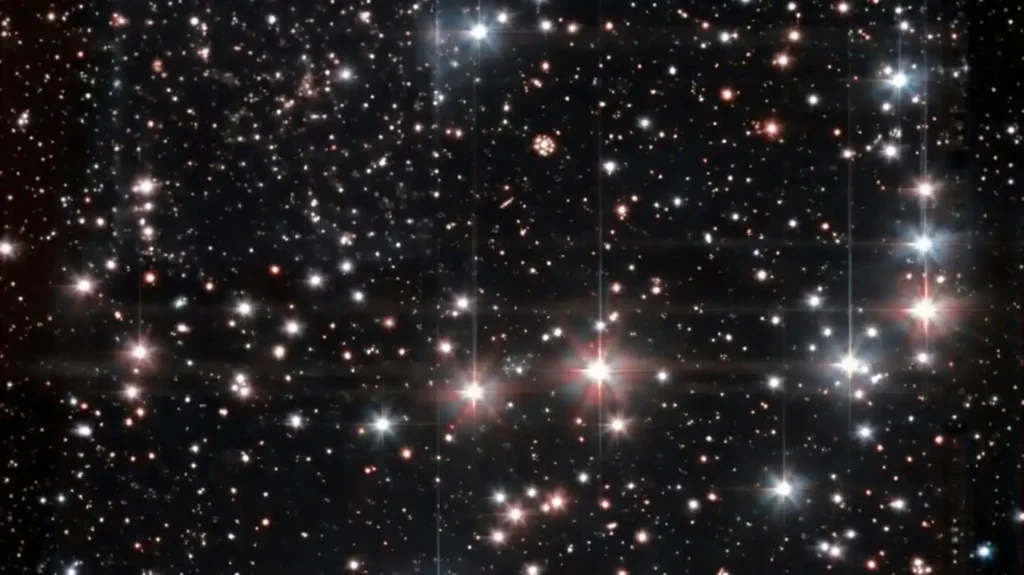
The discovery traces back to images from the Pan-Andromeda Survey, later verified using the Gran Telescopio Canarias, one of the world’s largest optical telescopes.
A Snapshot from the Early Universe
What makes this find exciting isn’t just how faint it is—but how old.
The stars inside Andromeda XXXVI are estimated to be around 12.5 billion years old. They’re also extremely metal-poor, meaning they formed when the universe was still young and hadn’t yet produced heavier elements.
That’s why scientists are calling it a possible “fossil galaxy”—a leftover from the earliest phases of galaxy formation, largely untouched since then.
Dark Matter Takes Centre Stage
Despite having very few visible stars, the galaxy appears to be heavily dominated by Dark Matter.
That imbalance—very little light, but significant mass—is exactly what makes ultra-faint dwarf galaxies like this so valuable. They act as natural laboratories where scientists can study how dark matter behaves on small cosmic scales.
Future observations, especially spectroscopic studies, are expected to measure its mass more precisely and confirm just how dark matter-heavy it really is.
Filling the Missing Pieces Around Andromeda
This discovery also ties into a bigger mystery.
Theories suggest that galaxies like Andromeda should be surrounded by up to 100 small satellite galaxies. But so far, astronomers have only confirmed about half of that number.
Finding Andromeda XXXVI brings researchers one step closer to closing that gap—and suggests there could be many more ultra-faint galaxies still waiting to be discovered.
Why This Discovery Matters
Andromeda XXXVI may be tiny, but its importance is anything but.
It offers a rare glimpse into the universe’s earliest building blocks, helps test long-standing theories about galaxy formation, and adds weight to the ongoing search for dark matter’s true nature.
In simple terms, this faint little galaxy might help answer some of the biggest questions in modern astronomy—and it’s only just been found.