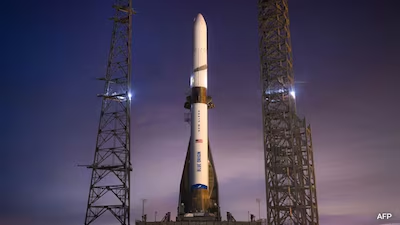
Blue Origin just hit a major milestone… and then almost immediately ran into a reality check.
On April 19, 2026, the company launched its massive New Glenn rocket using a previously flown booster for the first time ever — something that puts it closer to competing in the reusable rocket race. The launch itself went smooth, the landing even better. But the mission didn’t fully stick the landing where it mattered most.
The Moment That Actually Worked — And It Was Huge
The 98-meter-tall rocket lifted off from Cape Canaveral early morning, carrying a communications satellite for AST SpaceMobile.
What made this flight special wasn’t just the payload — it was the booster underneath. This wasn’t a fresh piece of hardware. It had already flown once before.
And it did it again.
After stage separation, the booster came back down and landed cleanly on Blue Origin’s floating platform “Jacklyn” in the Atlantic. Engineers reportedly broke into cheers — and yeah, that reaction makes sense.
Because this is the whole game now. Reusability.
If Blue Origin wants to compete long-term, especially against SpaceX, it needs rockets that don’t get thrown away after one flight. New Glenn boosters are designed for up to 25 missions, so proving they can actually be reused… that’s a big step.
Why This Matters More Than Just One Launch
This wasn’t just a technical flex. It’s about cost, frequency, and survival in the space industry.
Reusable rockets mean cheaper launches. Cheaper launches mean more missions. And more missions mean staying relevant in a space race that’s getting crowded fast.
SpaceX already built its reputation on this idea with Falcon 9. Blue Origin is now trying to catch up — and this was their first real proof that they can.
Then Things Started Going Wrong
But here’s where the story shifts.
While the booster did everything right, the second stage didn’t.
Due to a problem during the upper-stage phase, the satellite — AST SpaceMobile’s BlueBird 7 — ended up in the wrong orbit. Not just slightly off. It was low enough that it eventually re-entered Earth’s atmosphere and was lost.
So yeah, the mission technically succeeded… and failed at the same time.
The Bigger Problem Isn’t the Booster — It’s Reliability
Landing rockets is impressive. But customers don’t pay for landings — they pay for successful payload delivery.
And right now, that’s where Blue Origin still has work to do.
Because future plans aren’t small. New Glenn is expected to support NASA missions, lunar projects, and large-scale satellite deployments. That requires consistency, not just isolated success.
A Step Forward… With a Reminder Attached
This launch kind of sums up where Blue Origin stands right now.
They’ve proven they can reuse hardware — which is massive. But they’ve also shown that the full mission pipeline still isn’t fully locked.
And in space, partial success doesn’t really count the same way.
Still, this wasn’t a failure overall. It was progress — just not clean progress.
And maybe that’s how most space breakthroughs actually happen… one win, one problem, both at the same time.