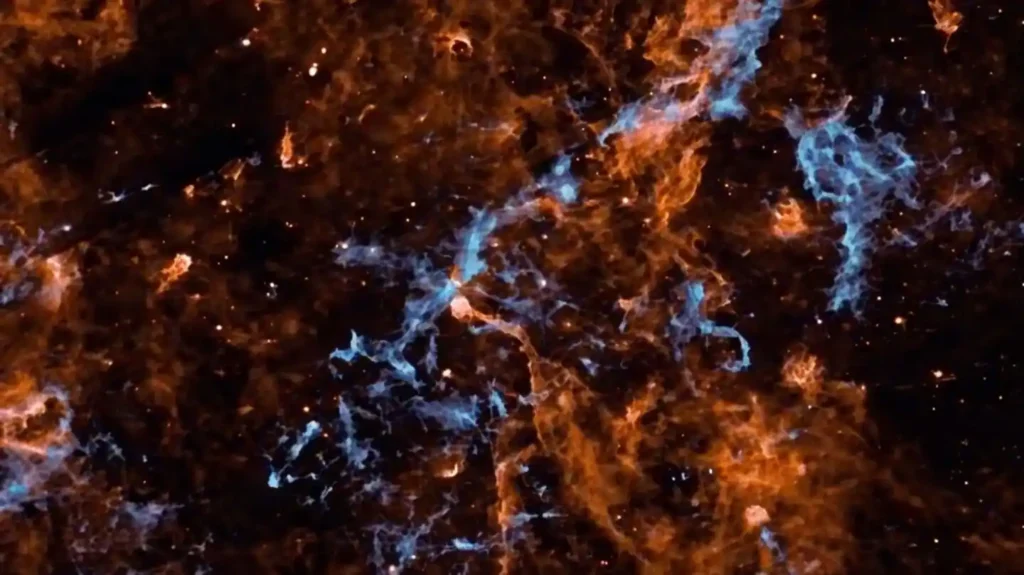
The question of where Earth’s water actually came from has always been one of those big, almost philosophical mysteries. Now, a fresh discovery from NASA is giving that question a surprisingly concrete direction. Scientists using the SPHEREx telescope have mapped enormous reservoirs of frozen water deep in space, inside the chaotic star-forming region known as Cygnus X. And the scale of it is honestly hard to ignore — these aren’t just traces, they’re massive interstellar ice structures spread across light-years.
What makes this discovery feel bigger than just another space update is what these “cosmic glaciers” actually contain. Along with frozen water, they hold complex molecules that are considered essential for life. That means we’re not just looking at ice floating around randomly, but at potential building blocks that could eventually shape planets, maybe even ecosystems. It shifts the conversation from “is there water out there?” to “how often does space actually prepare the ingredients for life before planets even exist?”
The research, published in The Astrophysical Journal, was led by astronomer Joseph Hora, and it dives into how this ice is surviving in such an intense region. Cygnus X is not calm or quiet — it’s one of the most active stellar nurseries in our galaxy. Despite that chaos, the ice is being preserved, and that’s where things get interesting. The answer seems to lie in dust, not the ordinary kind, but extremely fine cosmic grains.
These dust particles form dense, dark lanes that act almost like shields. They block harsh radiation and create pockets where ice can survive for long periods without breaking apart. In some areas, these grains are even smaller than cigarette smoke particles, yet they’re doing a massive job in protecting delicate molecules. It’s kind of ironic that something so tiny is helping preserve something so crucial on such a massive scale.
And this is where the bigger picture starts forming. As new stars and planetary systems begin to take shape, they pull in surrounding material through gravity. That includes these icy deposits. Over time, those same frozen molecules can become part of forming planets, potentially delivering water and life-supporting compounds right at the beginning. So instead of planets creating water later, it might already be built into them from the start.
SPHEREx itself is still early in its mission, having launched in March 2025, and it’s scanning the sky across 102 infrared wavelengths. Over the next couple of years, it will continue mapping how ice is distributed across the galaxy. This means what we’re seeing now might just be the beginning, not the full picture. There’s a good chance even more complex patterns will emerge as the data builds up.
What really works about this discovery is how it connects multiple dots at once — space chemistry, planet formation, and the origin of life. What remains uncertain, though, is how consistent this process is across different regions of the galaxy. Not every star-forming area may behave like Cygnus X, and that’s something future observations will need to confirm.
Still, this changes the tone of the conversation in a subtle but important way. Instead of asking whether Earth’s water is rare or unique, we might need to start asking how common this entire process actually is. And if space is quietly seeding planets with water long before they fully form, then the idea of life elsewhere doesn’t feel as distant as it once did.