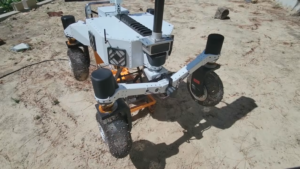
After surviving more than 13 years on the brutal surface of Mars, enduring freezing temperatures, radiation, dust storms, and endless mechanical stress, NASA’s Curiosity Rover was unexpectedly stopped by something much smaller — a stubborn rock that simply refused to detach from its drill.
The unusual incident reportedly left Curiosity temporarily stuck for six days after the rover attempted to collect a geological sample from a Martian rock formation nicknamed “Atacama” by NASA engineers. While the situation never placed the rover in critical danger, the problem became one of the stranger engineering challenges the mission has faced in recent years.
The trouble began on April 25, when Curiosity used its rotary-percussive drill system to extract material from the rock sample. Normally, the drill pulverizes rock into fine powder so the rover’s onboard scientific instruments can analyze mineral composition and study the geological history of Mars. But this time, something unexpected happened during the extraction process.
Instead of simply breaking apart as intended, the entire rock apparently lifted out of the ground and remained stuck to the drill bit after sampling. According to reports, the Atacama rock measured roughly 1.5 feet wide at its base, around six inches thick, and weighed approximately 13 kilograms. In simple terms, Curiosity accidentally ended up dragging around a surprisingly heavy chunk of Mars attached directly to its robotic arm.
And honestly, the images alone sound almost absurd considering the scale of the mission. A multi-billion-dollar robotic explorer designed to study another planet ended up stalled because one rock refused to let go. NASA engineers immediately started working on solutions remotely from Earth. Their first attempt involved vibrating the drill system in hopes that the motion alone would shake the rock loose. But Atacama reportedly held on stubbornly without moving.
A few days later, engineers tried another strategy by rotating Curiosity’s robotic arm while activating the drill vibrations again. This second attempt managed to release some surrounding sand and debris, but the rock itself still remained attached to the drill mechanism. Finally, on May 1, the team adjusted the drill angle more aggressively and combined vibrations with simultaneous drill rotation. This time, the approach worked almost immediately. On the very first attempt using the modified method, the Atacama rock finally broke apart and dropped back onto the Martian surface, freeing the rover to continue operations.
The successful fix allowed Curiosity to resume its scientific mission after nearly a week of delays. Even though the incident sounds relatively minor, situations like this highlight just how delicate and unpredictable robotic exploration can become millions of miles away from Earth. Engineers cannot physically touch the rover or repair it directly, meaning every mechanical issue has to be solved remotely through carefully calculated commands transmitted across space.
Curiosity’s drill system remains one of the rover’s most important scientific tools because it allows researchers to study material beneath Mars’ weathered surface layer. By analyzing powdered rock samples, scientists can investigate ancient water activity, mineral formation, and environmental conditions that existed billions of years ago when Mars may have been far more habitable than it is today.
Over the years, Curiosity has already made several major discoveries, including evidence of ancient lakes, organic molecules, and chemical conditions that once could have supported microbial life. Even after more than a decade on Mars, the rover continues delivering valuable geological data despite aging hardware and increasingly difficult terrain.
What makes the Atacama incident especially interesting is how small and random the problem was compared to the massive engineering threats Curiosity routinely survives. The rover is built to withstand one of the harshest environments imaginable, yet an oddly shaped rock still managed to interrupt operations for nearly a week.
In many ways, that unpredictability is exactly what makes planetary exploration so complicated. Mars constantly presents situations engineers could never fully simulate on Earth beforehand. Every drill attempt, terrain crossing, and robotic movement involves interacting with an alien environment where even a single rock can behave differently than expected.
Thankfully for NASA, Curiosity is now back to doing what it was sent there to do — drilling into ancient Martian geology and helping scientists slowly piece together the long history of the Red Planet, one stubborn rock at a time.