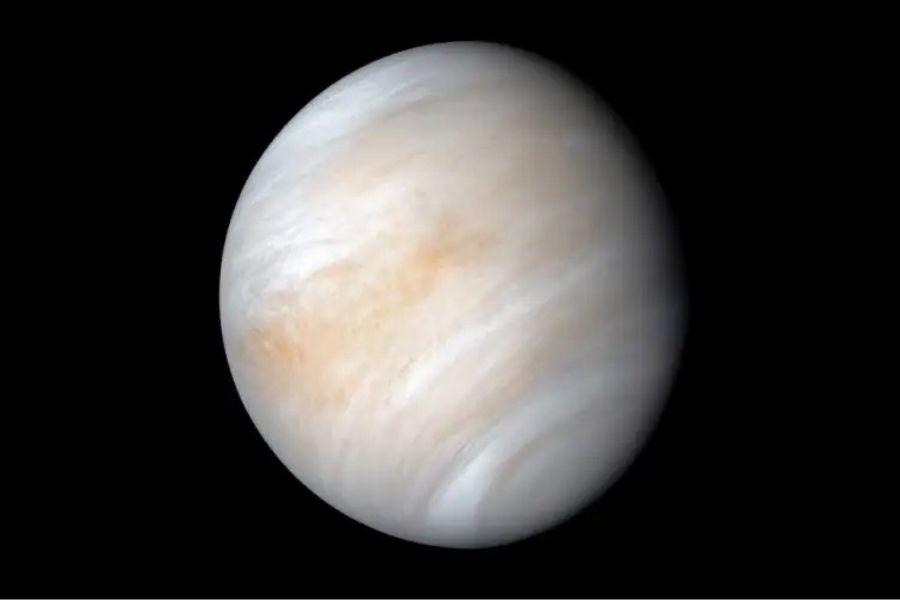
For decades, Venus has remained one of the most confusing worlds in our solar system. Beneath its thick blanket of toxic sulfuric acid clouds, the planet hides some of the strangest weather behaviour scientists have ever seen. One mystery in particular kept researchers scratching their heads for years — a gigantic cloud structure stretching nearly 3,700 miles across the planet, moving incredibly fast while maintaining a surprisingly sharp edge.
Now, scientists believe they’ve finally figured out what’s happening, and strangely enough, the explanation connects to something people see almost every day in their kitchen sink.
According to a new study published in the Journal of Geophysical Research: Planets, researchers from the University of Tokyo used advanced numerical simulations to understand how this enormous atmospheric phenomenon forms over Venus. What they discovered was something no one had ever identified beyond Earth before — a giant hydraulic jump happening inside Venus’s atmosphere.
The physics behind it actually sounds simpler than the discovery itself. When water from a faucet hits the bottom of a sink, it spreads out quickly in a thin layer before suddenly slowing down and thickening into a circular ring. That sudden transition is known as a hydraulic jump. Scientists now believe a similar process is happening high above Venus, except instead of water, the effect involves atmospheric waves and sulfuric acid clouds moving across an entire planet.
Researchers say the process begins with something called a Kelvin wave travelling eastward through Venus’s lower cloud layers. As the wave becomes unstable, it creates an intense upward motion in the atmosphere. That updraft then pushes vaporised sulfuric acid nearly 31 miles upward into the sky, eventually forming the huge bright cloud front scientists have been observing for years.
What makes the finding even bigger is the scale involved. Scientists say this is now the largest hydraulic jump ever discovered anywhere in the solar system. More importantly, it’s also the very first time the phenomenon has been observed outside Earth. That alone makes the discovery a major milestone in planetary science because it shows that familiar fluid physics can operate in extreme alien environments too.
The research may also help solve another long-running Venus mystery that has confused astronomers for decades. Even though Venus rotates extremely slowly, its atmosphere spins wildly fast around the planet in a phenomenon called “superrotation.” The clouds complete a full trip around Venus nearly 60 times faster than the planet itself rotates. Until now, scientists struggled to explain how the atmosphere maintained that kind of speed for such long periods.
The new study suggests the Kelvin wave and hydraulic jump system may be transferring momentum into the atmosphere, effectively helping keep the superrotation alive. Researchers say this kind of atmospheric coupling is completely missing from current climate models of Venus, meaning scientists may need to rethink parts of how the planet’s weather system actually works.
That also means future Venus exploration missions could benefit heavily from this discovery. Space agencies around the world have started paying renewed attention to Venus in recent years, with several new probes and orbital missions currently being planned. Understanding how the atmosphere behaves is considered critical before sending more advanced spacecraft into the planet’s hostile environment.
Scientists also admit incorporating this newly discovered mechanism into climate simulations will not be easy. The calculations require enormous computing power because Venus’s atmosphere behaves in ways very different from Earth’s. But researchers believe the effort will be worth it because the findings could improve not only Venus studies, but also humanity’s broader understanding of planetary atmospheres across the solar system and possibly even distant exoplanets. For a planet often called Earth’s evil twin, Venus just became even stranger — and somehow, your kitchen sink helped explain it.