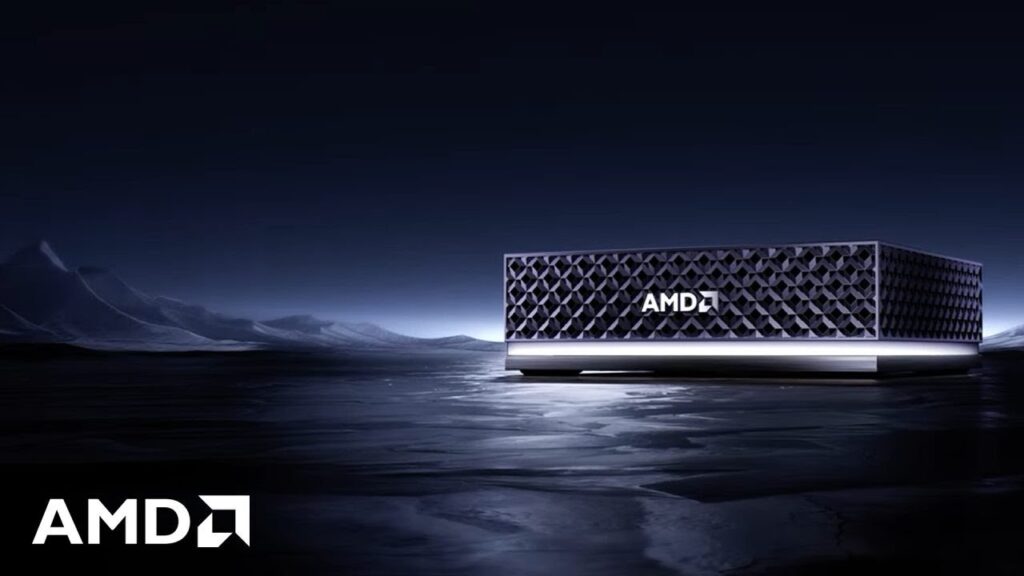
AMD is making a pretty aggressive push into the AI hardware race, and the company’s latest message feels very clear right now — maybe developers won’t need cloud AI services forever. During CES earlier this year, AMD first showed off its compact Ryzen AI Halo PC, a small but extremely powerful machine designed specifically for heavy AI workloads. Now the company has officially revealed pricing details, and the system is definitely not aimed at casual users. The base configuration will reportedly start at $3,999 with Ryzen AI Max 300 processors, while even more powerful versions using the upcoming Ryzen AI Max 400 chips are expected later in 2026.
At first glance, the price looks expensive, but AMD is pitching the device as a long-term money saver for developers and AI researchers who constantly pay large cloud computing bills every month. According to the company, developers using around six million AI tokens daily could spend roughly $773 every month on cloud processing alone. In AMD’s argument, buying a Ryzen AI Halo machine could basically recover its cost within six months. For people running larger workloads, AMD claims its upcoming Radeon R9700 Pro GPU could pay for itself even faster compared to expensive cloud subscriptions used for advanced AI development.
AMD Is Directly Challenging NVIDIA’s AI Machines
This new AI-focused system clearly puts AMD into direct competition with NVIDIA and its DGX Spark AI PC lineup. NVIDIA’s machine currently sells for around $4,699 and mainly targets professional AI developers and engineers. But AMD seems to believe it has a few important advantages that could help it stand out in the growing local AI computing market.
One major difference is flexibility. NVIDIA’s DGX Spark reportedly runs only on Linux, while AMD’s Ryzen AI Halo systems can support both Windows and Linux because of the x64 architecture. That could matter a lot for developers who don’t want to fully shift into Linux environments for AI work. AMD is also leaning heavily into balanced hardware performance instead of relying only on GPU power. The Ryzen AI Halo setup includes a 50 TOPS neural processing unit alongside Radeon graphics with 40 compute units, giving the system multiple ways to handle AI workloads locally.
Memory is another big selling point here. Both AMD’s Halo machine and NVIDIA’s DGX Spark include 128GB of unified memory, which is becoming increasingly important for running large AI models efficiently. Interestingly, AMD pointed out that even popular AI development machines like Mac mini and Mac Studio cannot currently reach that level of memory configuration. That detail alone could make AMD’s platform more attractive for developers working with massive local language models and generative AI systems.
Ryzen AI Max 400 Chips Push AMD Even Further Into AI
AMD also used the announcement to tease its upcoming Ryzen AI Max 400 series processors, which are expected to arrive during the third quarter of 2026. The lineup will reportedly be led by the Ryzen AI Max+ Pro 495, a 16-core processor capable of boosting up to 5.2GHz. Alongside faster CPU performance, the chip will feature a 55 TOPS NPU and Radeon 8065S graphics, showing how seriously AMD is taking AI acceleration moving forward.
One of the biggest upgrades coming with the Max 400 series is support for up to 192GB of unified memory, including as much as 160GB dedicated as GPU VRAM. That amount of memory honestly starts pushing these systems closer to workstation territory rather than traditional desktop PCs. Even though AMD says the performance jump over the current AI Max 395 chip may not look massive on paper, the extra memory support alone could become a huge deal for developers running larger local AI models.
Right now, the bigger picture here feels pretty obvious. Companies like AMD and NVIDIA are no longer just selling gaming hardware or standard workstation chips anymore. The real battle is becoming about who controls the future of local AI computing, especially as developers grow frustrated with rising cloud costs and subscription-heavy AI ecosystems. AMD seems to believe there’s a growing audience ready to keep AI processing on their own machines instead of renting computing power forever.