Nvidia is tightening its grip on the global AI race, and this time South Korea has become the center of attention. During a packed visit to Seoul, Nvidia CEO Jensen Huang unveiled a string of new partnerships with some of the country’s biggest technology and industrial companies. The agreements touch nearly every major area of the artificial intelligence ecosystem, from advanced memory chips to large-scale AI data centers and even humanoid robotics.
The announcements arrive at a moment when demand for AI infrastructure is growing faster than many companies can build it. Training modern AI models now requires enormous computing power, massive energy resources, and a steady flow of advanced memory chips. By strengthening ties with South Korean giants, Nvidia appears to be securing several key pieces of that puzzle at once.
Nvidia Locks In Crucial AI Memory Supply
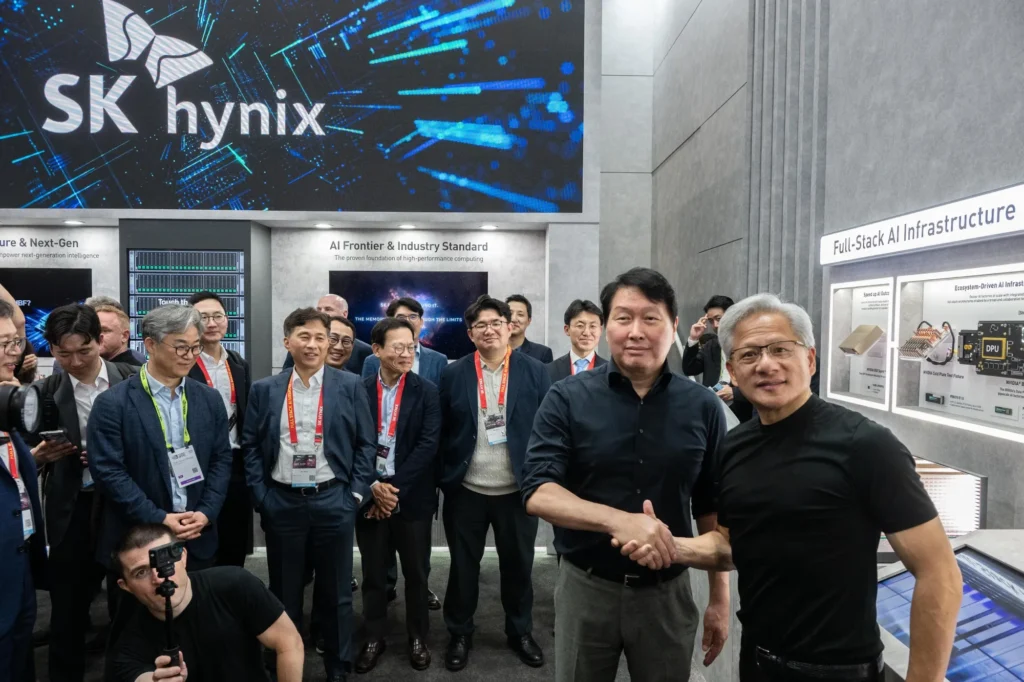
One of the most significant developments from Huang’s trip involves a new multi-year partnership with memory chip leader SK Hynix. While financial details were not revealed, both companies made it clear that the relationship goes far beyond a routine supplier agreement.
SK Hynix has become one of the most important players in the AI boom because of its dominance in High Bandwidth Memory (HBM), a critical component used in Nvidia’s AI accelerators. These specialized memory chips help AI systems process huge amounts of data at high speed, making them essential for training and running advanced models. As demand for AI hardware continues to surge worldwide, securing long-term access to these components has become a strategic priority for Nvidia.
Speaking after a meeting with SK Group Chairman Chey Tae-won, Huang emphasized the importance of the partnership and highlighted how deeply the two companies are already connected. “SK Hynix has been Nvidia’s largest memory partner. SK Hynix will continue to be Nvidia’s largest memory partner,” Huang said.
He also revealed that Nvidia already spends billions of dollars annually purchasing memory from SK Hynix and expects that figure to rise significantly in the coming years. The agreement reportedly covers more than two years, with opportunities to extend the collaboration further as AI demand continues expanding into robotics, AI supercomputers, personal computing devices, and next-generation enterprise systems.
Industry analysts see the partnership as another sign that memory chips are no longer being treated as simple commodity products. Instead, manufacturers are increasingly working closely with customers to design memory solutions tailored for specific AI workloads and computing architectures.
South Korea Becomes a Major AI Infrastructure Hub
Beyond memory chips, Nvidia announced several partnerships focused on building the next generation of AI infrastructure inside South Korea. Telecommunications giant SK Telecom revealed plans to develop a gigawatt-scale AI cloud platform powered by Nvidia technologies, with its first AI data center expected to become operational in 2027.
The scale of the project reflects a broader trend happening across the industry. As AI models become larger and more complex, companies are racing to build massive facilities capable of handling unprecedented computing requirements. Data centers that once served traditional cloud workloads are increasingly being redesigned specifically for AI processing.
Nvidia also confirmed that internet giant Naver and industrial conglomerate Doosan will deploy Nvidia technologies in upcoming AI data center projects. For Naver, the move strengthens its ambitions to compete more aggressively in AI services and cloud computing. For Doosan, the collaboration extends beyond infrastructure and includes opportunities involving robotics, industrial automation, and physical AI applications.
Doosan has already established itself as a supplier of materials used in Nvidia’s powerful Blackwell AI systems. Company executives indicated they expect their energy technologies to play a role in future Nvidia-powered data center platforms as the industry searches for more efficient ways to support rapidly growing power demands.
AI Partnerships Expand Beyond Data Centers
Huang’s South Korea visit wasn’t limited to cloud infrastructure and semiconductor discussions. Nvidia is also working with LG Group on a range of future-focused technologies that could become major growth areas over the next decade.
According to Huang, the companies are collaborating on electronics, mechanical systems, and artificial intelligence technologies that could support humanoid robots and advanced automation platforms. While details remain limited, the partnership highlights Nvidia’s broader strategy of expanding beyond traditional graphics and AI chips into complete AI ecosystems.
The discussions reportedly include future data center architecture as well. Cooling systems, power delivery networks, facility design, and overall infrastructure efficiency have become major challenges as AI computing requirements continue climbing. Solving those problems is increasingly becoming as important as designing faster processors.
This reflects a major shift in the AI industry. A few years ago, most attention centered on graphics processors and model development. Today, companies are realizing that success in AI requires a complete stack that includes hardware, memory, networking, software, power management, and large-scale infrastructure.
Why These Deals Matter for the AI Industry
The announcements reinforce South Korea’s growing importance in the global AI supply chain. The country is already home to two of the world’s largest memory chip manufacturers, Samsung Electronics and SK Hynix, both of which play critical roles in supplying components for AI servers and data centers.
Nvidia’s decision to deepen relationships with multiple Korean companies suggests that future AI growth will depend heavily on international partnerships rather than any single technology provider. Building AI infrastructure at scale now requires cooperation between semiconductor firms, telecom operators, industrial manufacturers, cloud providers, and software companies.
The timing is particularly notable because AI spending shows little sign of slowing despite recent market volatility. South Korean technology stocks experienced sharp declines after stronger-than-expected U.S. economic data triggered concerns about future interest rate decisions. Shares of Samsung Electronics and SK Hynix both came under pressure during trading, mirroring broader weakness across global technology markets.
Huang, however, appeared unfazed by the selloff. Commenting on the downturn, he suggested investors should view lower stock prices as an opportunity rather than a warning sign. “Everybody should be very excited; they can now buy stock at a cheaper price, and it’s absolutely true that the future of AI is very bright.”
His confidence reflects Nvidia’s broader outlook. Despite growing competition from companies such as AMD, Intel, Google, Amazon, Microsoft, and a wave of AI chip startups, Nvidia remains at the center of the industry’s infrastructure buildout. The new agreements announced in South Korea show the company is still moving aggressively to secure the partnerships, resources, and technology needed to power the next phase of the AI revolution.