Space science just got a massive upgrade — and it’s happening faster than expected. Even before officially starting its full survey, the Rubin Observatory has already delivered a staggering breakthrough, spotting thousands of new asteroids and sharpening our understanding of space around Earth.
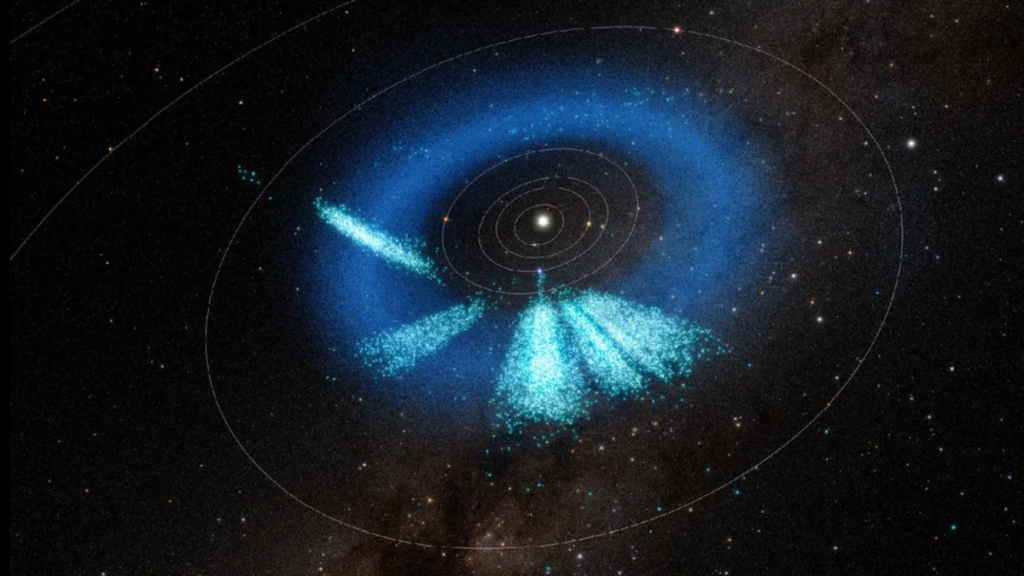
In just a few weeks of early observations, the observatory has detected more than 11,000 previously unknown asteroids. That alone would be impressive — but what really stands out is the scale. Alongside these discoveries, scientists have also refined the orbital paths of nearly 80,000 known objects, making tracking far more accurate than before.
At the heart of this speed is Rubin’s powerful setup. Its massive 8.4-meter camera paired with a 3.2-gigapixel imaging system allows it to scan huge portions of the sky in a single sweep. In fact, it can cover the entire southern sky within just a few nights — something that used to take much longer with older systems.
And it’s not just about numbers.
Among the newly discovered objects are 33 near-Earth asteroids — the kind that scientists watch closely because their paths bring them near our planet’s orbit. The good news? None of them pose any immediate threat. But their detection is still a big deal. Early identification is key when it comes to planetary defence, and this is exactly where Rubin is expected to make a long-term impact.
Beyond that, the observatory has also picked up hundreds of icy objects located far beyond Neptune, offering fresh data about the outer edges of our solar system. These findings help scientists piece together how planets and smaller bodies formed and evolved over billions of years.
What makes this moment even more exciting is that this is just the beginning. These discoveries came from what is essentially a preview phase — not the full mission. Once the main survey begins, expectations are sky-high. Scientists believe Rubin could triple the total number of known asteroids and significantly increase the count of large near-Earth objects being tracked.
This shifts the conversation in two major ways.
First, from a science perspective, it gives researchers a much clearer map of our solar system’s structure and history. Second, from a safety standpoint, it strengthens Earth’s ability to detect and monitor potentially hazardous objects much earlier than before.
In simple terms, Rubin Observatory isn’t just finding rocks in space — it’s building one of the most detailed, real-time maps of our cosmic neighbourhood.
And if this early performance is anything to go by, we’re only just getting started.