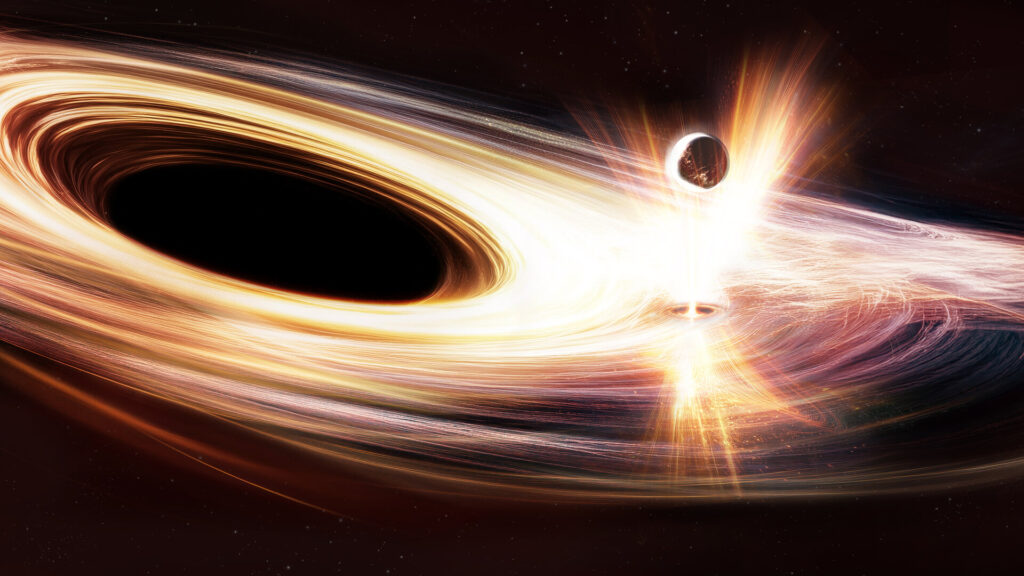
Astronomers may finally be getting closer to solving one of the strangest mysteries surrounding giant black holes. A new study suggests that some of the heaviest black holes ever detected in space were probably not born directly from collapsing stars like scientists originally believed. Instead, researchers now think many of them could actually be the result of repeated black hole collisions happening over millions of years inside crowded star clusters.
The research, recently published in Nature Astronomy, analysed gravitational-wave signals collected from 153 separate black hole mergers detected by the LIGO, Virgo Collaboration, and KAGRA observatories. These observatories track ripples in space-time itself, known as gravitational waves, which are produced when massive cosmic objects like black holes crash into each other.
What makes the findings interesting is that the scientists noticed two very different black hole “families” appearing inside the data. Smaller black holes mostly showed slow and neatly aligned spins, which is exactly what astronomers expect when a massive dying star collapses inward and forms a black hole naturally. That part wasn’t surprising. But the heavier black holes looked very different from that pattern.
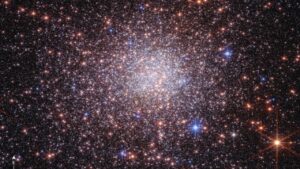
The giant black holes observed in the study showed chaotic spin directions and much faster rotations, something researchers believe points toward repeated merger events instead of normal stellar collapse. In simple terms, scientists think smaller black holes may be smashing together again and again inside dense star clusters, slowly building larger and larger black holes over time like cosmic stacking blocks.
One of the biggest clues supporting this theory comes from something astronomers call the “pair-instability mass gap,” often nicknamed the forbidden zone or mass desert. This mysterious region exists between roughly 50 and 130 times the mass of our Sun. According to current stellar physics, stars in this range are not supposed to leave black holes behind after dying because they explode too violently before a black hole can properly form.
The study now suggests that many giant black holes detected inside or near this forbidden zone may have bypassed those limits completely through hierarchical mergers. That means instead of being created directly from stars, they were assembled from the leftovers of earlier black hole collisions. Scientists involved in the research estimate the important threshold begins around 45 solar masses, where black hole behaviour starts shifting noticeably.
This idea also helps explain why some recently detected black holes appeared far heavier than traditional theories predicted. Ever since gravitational-wave astronomy became more advanced over the last decade, researchers have repeatedly discovered black holes that seemed too massive to comfortably fit existing models. Those discoveries left astronomers wondering whether something fundamental was missing in our understanding of black hole formation.
The growing catalogue of gravitational-wave detections is now changing how scientists look at the universe’s most extreme objects. Before observatories like LIGO became operational, black holes were mostly studied indirectly through light and radiation around them. Gravitational waves opened a completely new way of observing space, allowing researchers to “hear” violent cosmic collisions happening billions of light-years away.
Many scientists believe this field is still only at the beginning. As gravitational-wave detectors become more sensitive in coming years, astronomers expect to discover even stranger black holes that could further challenge existing theories. Some researchers even think future observations may uncover entirely new categories of cosmic objects hiding inside deep space.
For now, though, this latest study strengthens the idea that the universe’s largest black holes may not be born giant at all. Instead, they could be growing slowly through generations of violent mergers, carrying the remains of smaller black holes inside them like cosmic fossils from earlier collisions.