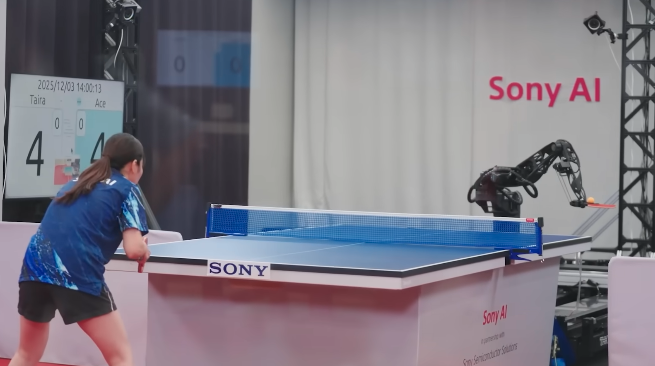
Something unusual just played out in Tokyo, and it’s not from a sci-fi film. A robot built by Sony has stepped into a real-world sport — table tennis — and didn’t just participate, but managed to defeat top human players in proper competitive matches. This isn’t a lab demo or controlled test either, the games followed official rules and were judged like any serious match. The moment feels small at first glance, but once you think about it, it quietly signals a much bigger shift in how AI is entering physical reality.
The robot is called Ace, and it comes from Sony’s AI research division, a unit that has been quietly working on pushing machines beyond screens and into real-time human environments. What makes this story stand out is not just that Ace can hit a ball, but that it can actually compete at a level where trained players struggle against it. The project leader described it as the first time a robot has reached expert-level performance in a physical sport, which is a very different challenge compared to games like chess or digital simulations.
A Game Where Speed Leaves No Room for Error
Table tennis might look simple when you casually watch it, but the reality is very different once you get into competitive play. The ball moves insanely fast, spins in unpredictable ways, and players react within fractions of seconds. For a machine to operate in that environment, it needs to sense, decide, and act almost instantly — there’s no pause button here.
Ace handles this using a complex system of nine synchronized cameras and multiple vision systems that track the ball in real time. The processing is so fast that even movements that look like a blur to humans are captured and analyzed by the robot. That’s where things start getting interesting, because this is not just about hitting back — it’s about reading spin, predicting movement, and executing precise shots under pressure.
How Ace Actually Performed Against Humans
In tests detailed in a study published in the journal Nature, Ace played multiple matches against elite and professional-level players. The results weren’t one-sided, which makes it more impressive. It managed to win three out of five matches against elite players, and even went on to defeat professional players in later sessions.
That’s not dominance yet, but it’s enough to show that the gap between humans and machines in physical sports is starting to close. Until now, robots could rally or play basic shots, but they couldn’t really challenge experienced players. Ace has clearly crossed that line, even if it still has weaknesses.
Players Found It Difficult to Read the Robot
One of the more fascinating parts of this story comes from the players themselves. Professional athlete Mayuka Taira admitted that playing against Ace felt strange because the robot shows no emotion at all. You can’t read its reactions, you can’t guess its strategy from body language, and that makes it harder to anticipate what’s coming next.
Another player, Rui Takenaka, noticed something even more interesting. When he used complex spin serves, the robot responded with equally complex returns, making rallies difficult. But when he switched to simpler serves, Ace responded more predictably, which gave him an opening to attack. That small detail shows that while the robot is powerful, it still has patterns — and humans are still better at exploiting them.
Why This Matters Beyond Sports
At first, this might look like just a cool robotics achievement, but the bigger picture is much wider. The same technology that allows Ace to track, predict, and react in milliseconds can be applied in industries where precision and speed are critical. Think manufacturing lines, service robots, or even safety systems where quick decisions can prevent accidents.
This is where things start connecting with a broader trend. AI has already dominated digital spaces like strategy games and simulations, but the physical world has always been tougher because of unpredictability. With Ace, that barrier is starting to crack. And when machines begin to handle real-world environments with this level of control, it changes how we think about automation entirely.
Not Perfect Yet — And That’s Important
Even with all this progress, the developers themselves admit that Ace is not unbeatable. Human players still have an edge when it comes to adapting mid-game and finding weaknesses. That’s something machines are still learning, and it’s probably going to be the next big step.
What’s interesting though is how Ace learns. It doesn’t just copy humans — it trains itself through simulations, which means it can develop playing styles that feel unfamiliar or even unpredictable to human opponents. That’s why players describe it as “hard to read,” and that unpredictability might actually become its biggest strength over time.
The Bigger Shift You Can’t Ignore
If you zoom out a bit, Ace isn’t just about table tennis. It’s part of a larger wave where robots are starting to match humans not just in thinking, but in doing. We’ve already seen machines outperform humans in digital tasks, but physical interaction has always been the real challenge. Now that line is getting thinner.
And honestly, this is where it gets a bit uncomfortable too. Because once robots start handling speed, precision, and decision-making better than us in the physical world, it opens up both exciting possibilities and serious questions. Where do humans still hold the advantage? And how long will that last?
For now, Ace is just playing ping pong. But it feels like the game it’s really changing is much bigger than that.