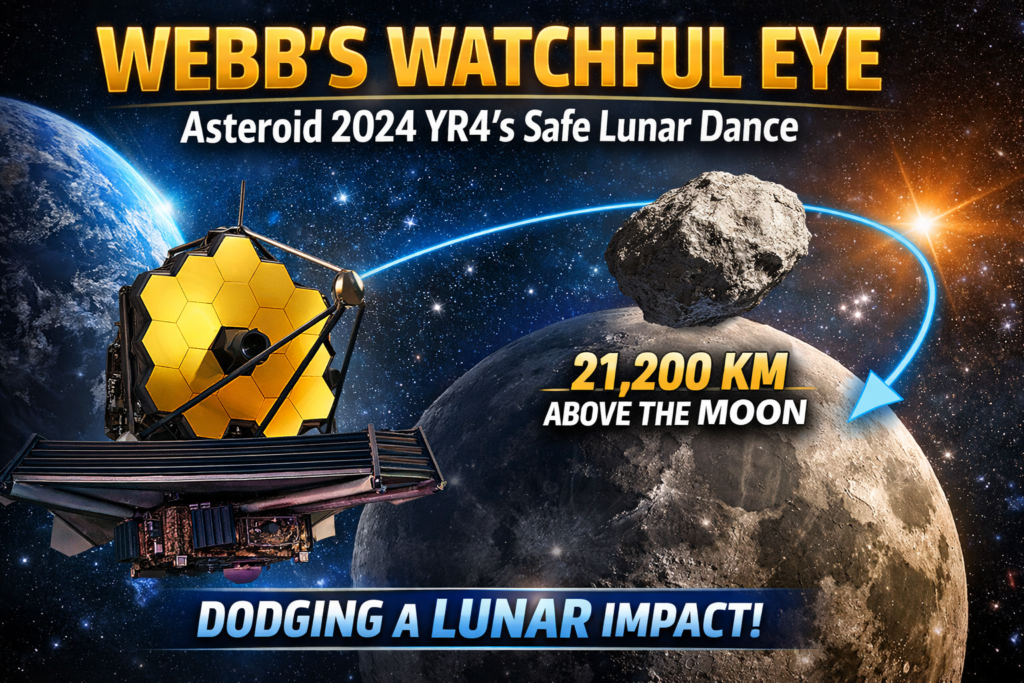
Webb’s Watchful Eye: Asteroid 2024 YR4’s Safe Lunar Dance
In a cosmic game of hide and seek, the James Webb Space Telescope has once again proven its prowess. Observations from this celestial marvel have decisively removed any risk of asteroid 2024 YR4 crashing into the Moon in December 2032. Instead, this sky-dweller will gracefully glide past at a comfortable distance of 21,200 kilometers above the lunar surface. It’s a relief for astronomers and space enthusiasts alike, showcasing the importance of advanced technology in keeping our cosmic neighborhood in check.
The saga of asteroid 2024 YR4 began when it was first spotted by the ATLAS survey in 2024. Its trajectory raised eyebrows, with a slight chance of an Earth impact. However, ongoing global tracking efforts have since assured us of its harmless path for the foreseeable future. The recent observations by Webb, conducted by the team at Johns Hopkins APL in February 2026, have been pivotal. These sessions revealed 2024 YR4 as a faint object, detected with remarkable clarity thanks to Webb’s sophisticated infrared capabilities.
Asteroids, those wandering remnants of our solar system’s formation, demand constant vigilance. NASA’s planetary defense strategy hinges on early detection, bolstered by international collaboration. The data collected from worldwide observatories are meticulously analyzed, with centers like JPL playing a crucial role. They utilize the CNEOS system to assess any potential threat an asteroid might pose, while the Asteroid Warning Network ensures that partners globally are promptly informed.
As for long-term strategies, surveys such as the NEO Surveyor are essential, along with innovative tests like the Double Asteroid Redirection Test (DART). These efforts underline the significance of early detection as our primary defense. The incident with asteroid 2024 YR4 highlights how far we’ve come in safeguarding our planet from celestial collisions. Thanks to the James Webb Telescope, what once seemed a potential hazard is now a fascinating flyby to look forward to in 2032.
For fans of cosmic events and space exploration, this scenario is a testament to the incredible strides we’ve made in understanding and protecting our universe. The collaboration between cutting-edge technology and dedicated scientists ensures that we can enjoy the wonders of space with peace of mind. So, mark your calendars for December 2032, not as a day of worry, but as a day to marvel at the skies above.
As we wrap up this celestial saga, it’s heartening to know that with each passing year, our cosmic defenses grow stronger, enabling us to gaze upwards with wonder and confidence. Here’s to more celestial dances without the drama!