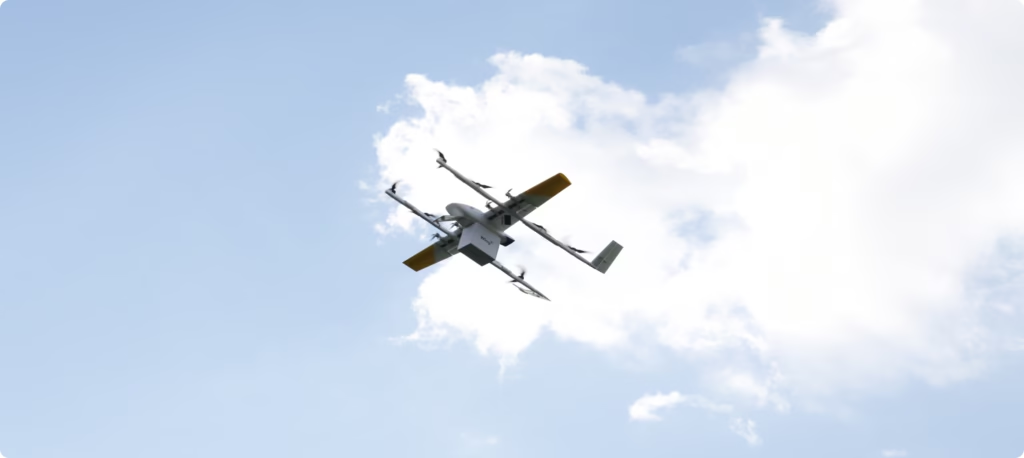
The future of delivery is slowly lifting off—quite literally. Alphabet Inc.’s drone delivery arm Wing is now preparing to bring its aerial logistics service to one of the most densely populated and tech-forward regions in the United States—the San Francisco Bay Area.
This move marks a significant step in Wing’s long-term ambition to transform how everyday items reach consumers. After years of testing and gradual expansion, the company is now gearing up to begin regular drone deliveries to homes in California in the coming months, signaling a shift from experimental trials to more practical, real-world deployment.
Interestingly, this expansion is also something of a homecoming.
Wing was originally founded in the Bay Area back in 2012 as part of X—Alphabet’s innovation lab known for developing ambitious, futuristic technologies. From self-driving cars like Waymo to experimental connectivity projects, X has long served as a launchpad for ideas that aim to redefine industries.
Now, more than a decade later, Wing is returning to its roots—but with a far more mature and proven model.
At its core, Wing is trying to solve one of the biggest challenges in modern logistics: last-mile delivery. This final step—getting a package from a local hub to a customer’s doorstep—is often the most time-consuming and expensive part of the delivery chain.
Wing’s solution is simple in concept but complex in execution.
Using lightweight, automated drones, the company aims to bypass traffic, reduce delivery times, and cut down operational costs. These drones are designed to fly directly to homes, even in dense residential areas, and lower packages safely to the ground without needing traditional infrastructure.
And this isn’t just theoretical anymore.
According to company data, Wing has already completed over 750,000 deliveries and currently serves more than two million customers across select regions in the United States. These numbers suggest that the technology is moving beyond the experimental phase and into scalable operations.
Partnerships have played a key role in this growth.
Wing has teamed up with major retailers like Walmart to deliver groceries and household essentials in under 30 minutes in certain U.S. markets. At the same time, its collaboration with DoorDash allows customers to receive food from popular restaurant chains such as Wendy’s and Panera with remarkable speed.
These partnerships highlight a broader trend in the delivery ecosystem.
Consumers today expect faster, more convenient service than ever before. Same-day delivery is becoming the norm, and in many cases, even that isn’t fast enough. Companies are now racing to find solutions that can deliver items in minutes rather than hours—and drone technology is emerging as one of the most promising answers.
The Bay Area rollout is particularly significant because of the region’s unique characteristics.
It combines high population density with a tech-savvy user base, making it an ideal testing ground for advanced delivery systems. However, it also presents challenges, including regulatory hurdles, airspace management, and public acceptance.
If Wing can successfully operate at scale here, it could pave the way for broader adoption in other major urban centers around the world.
The company is also experimenting with hybrid delivery models.
In late 2024, Wing launched a pilot program with Serve Robotics, where ground-based robots collect food from restaurants and transfer it to drones for aerial delivery. This combination of ground and air logistics represents a more integrated approach, potentially making the entire delivery process faster and more efficient.
From an industry perspective, this signals a shift toward multi-layered delivery networks.
Instead of relying solely on trucks, bikes, or human couriers, companies are exploring systems where different technologies work together to optimize speed and cost. Drones handle the final leg, robots manage short-distance pickups, and centralized hubs coordinate the flow of goods.
It’s a complex system—but one that could redefine logistics as we know it.
Of course, challenges remain.
Regulatory approvals, safety concerns, noise levels, and public perception are all factors that could influence how quickly drone delivery becomes mainstream. While early adopters may embrace the convenience, widespread acceptance will depend on how seamlessly the technology integrates into daily life.
There’s also the question of scalability.
Operating drone networks in controlled pilot zones is one thing; expanding them across large urban areas with millions of residents is another. Infrastructure, coordination, and cost efficiency will all play critical roles in determining whether companies like Wing can sustain long-term growth.
Still, the momentum is undeniable.
With major tech companies investing heavily in logistics innovation, the race to redefine delivery is accelerating. From autonomous vehicles to AI-driven supply chains, the industry is undergoing a transformation—and drones are becoming a key part of that evolution.
For Alphabet, Wing represents more than just a delivery service.
It’s a glimpse into a future where technology removes friction from everyday tasks, making services faster, smarter, and more efficient. And with its return to the Bay Area, that future feels closer than ever.
If successful, the sight of drones quietly delivering groceries or meals could soon become as normal as seeing delivery bikes on the street.
And when that happens, the way we think about “delivery” might change forever.