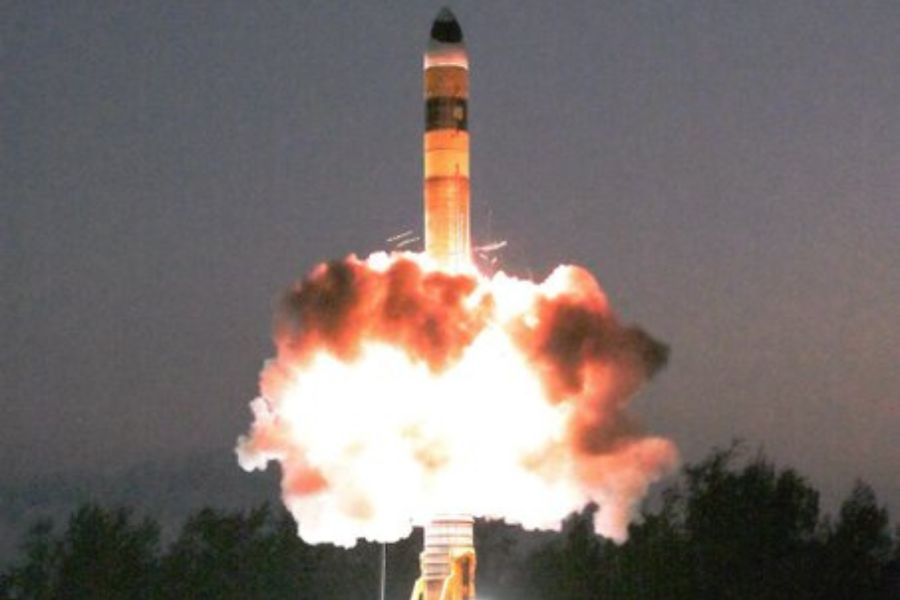
India has once again pushed its long-range defence capability into a new league after successfully conducting another flight trial of the advanced Agni-5 missile equipped with MIRV technology. The test, carried out from Dr APJ Abdul Kalam Island in Odisha on Friday, is being seen as a major moment for the country’s strategic deterrence programme, especially at a time when regional security equations continue changing rapidly across Asia.
The Defence Ministry confirmed on Saturday that the missile successfully carried multiple payloads aimed at different targets spread across a large geographical region in the Indian Ocean. What makes this important is the MIRV system itself. Unlike traditional ballistic missiles that carry a single warhead, MIRV — short for Multiple Independently Targetable Re-entry Vehicle — allows one missile to deploy several nuclear warheads toward separate targets during a single mission. That massively increases the reach and impact capability of the system.
The successful test also shows how much India’s indigenous missile technology has evolved over the years under the Defence Research and Development Organisation (DRDO). Officials said the mission objectives were fully achieved and the missile’s entire trajectory was monitored using both ship-based and ground-based tracking systems. From launch to impact, telemetry data reportedly confirmed accurate performance across all stages.
The Agni-5 itself already sits among India’s most powerful long-range missile systems. Powered by a three-stage solid-fuel engine, the missile can strike targets located over 5,000 kilometres away. With the addition of MIRV capability, the weapon system becomes far more complex and strategically valuable because a single launch can threaten multiple enemy assets at once. Military experts tracking the project believe the missile could carry four to five warheads, though officials have not publicly confirmed the exact number.
Defence Minister Rajnath Singh described the test as a huge boost for India’s defence preparedness. The trial also builds on the earlier historic Agni-5 MIRV launch conducted in March 2024, which Prime Minister Narendra Modi had famously named “Mission Divyastra.” That earlier launch officially pushed India into a highly exclusive group of countries capable of deploying MIRV-equipped missile systems. The club currently includes nations like the United States, Russia, China, France, and the United Kingdom.
Strategically, MIRV systems are considered game-changing because they can overwhelm missile defence shields. Instead of intercepting one incoming warhead, enemy systems may suddenly need to stop several independently guided payloads approaching different locations. This dramatically improves survivability and second-strike capability during nuclear conflict scenarios. Defence analysts believe this is one reason major powers continue investing heavily in MIRV technology even decades after the Cold War.
India’s broader Agni missile programme has steadily expanded over the years. Earlier variants include the Agni-1 with a 700-km range, Agni-2 reaching around 2,000 km, Agni-3 at roughly 3,000 km, and Agni-4 extending close to 4,000 km. But the Agni-5 remains the crown jewel of the programme because of its intercontinental reach and now its advanced MIRV integration. Officials also highlighted that the system uses indigenous avionics and highly accurate sensor packages developed within the country, another sign of India reducing dependence on foreign defence technology.
One of the more talked-about aspects of the original 2024 Mission Divyastra test was the leadership role played by women scientists from DRDO. The mission became symbolic not only for India’s military advancement but also for the growing visibility of women in high-level strategic and scientific projects. That detail again resurfaced after the latest trial as discussions around India’s defence ecosystem continued online.
The missile test also arrives at a sensitive geopolitical moment. India continues balancing security concerns involving both Pakistan and China, especially with Beijing rapidly expanding its own missile and nuclear capabilities. According to last year’s Stockholm International Peace Research Institute report, China’s nuclear arsenal was estimated at around 600 warheads, significantly larger than India’s estimated 180. Pakistan’s arsenal was estimated at roughly 170 warheads. Even though numbers tell one story, strategic capability and delivery systems tell another — and this is where Agni-5 MIRV becomes especially important for New Delhi.
India’s nuclear doctrine still officially follows a “No First Use” policy that was announced in 2003. Under this doctrine, nuclear weapons would only be used in retaliation against a nuclear attack on Indian territory or Indian armed forces. However, the doctrine also makes it clear that any retaliatory strike would be massive enough to inflict what officials once described as “unimaginable damage.” Decisions regarding nuclear retaliation remain under civilian political leadership through the Nuclear Command Authority headed by the Prime Minister.
Apart from land-based missiles, India has also been strengthening the sea and air legs of its nuclear triad. Earlier this year, the Indian Navy quietly commissioned INS Aridaman, the country’s third nuclear-powered ballistic missile submarine, during a confidential ceremony in Visakhapatnam. That addition further improves India’s ability to launch nuclear weapons from land, air, and sea — a capability possessed by only a handful of countries globally.
The latest Agni-5 MIRV success is not just another missile test. It is also a statement about where India wants to position itself strategically over the next decade. As defence competition intensifies globally and Asian security dynamics continue becoming more unpredictable, long-range deterrence systems like Agni-5 are likely to remain at the centre of India’s military planning for years ahead.