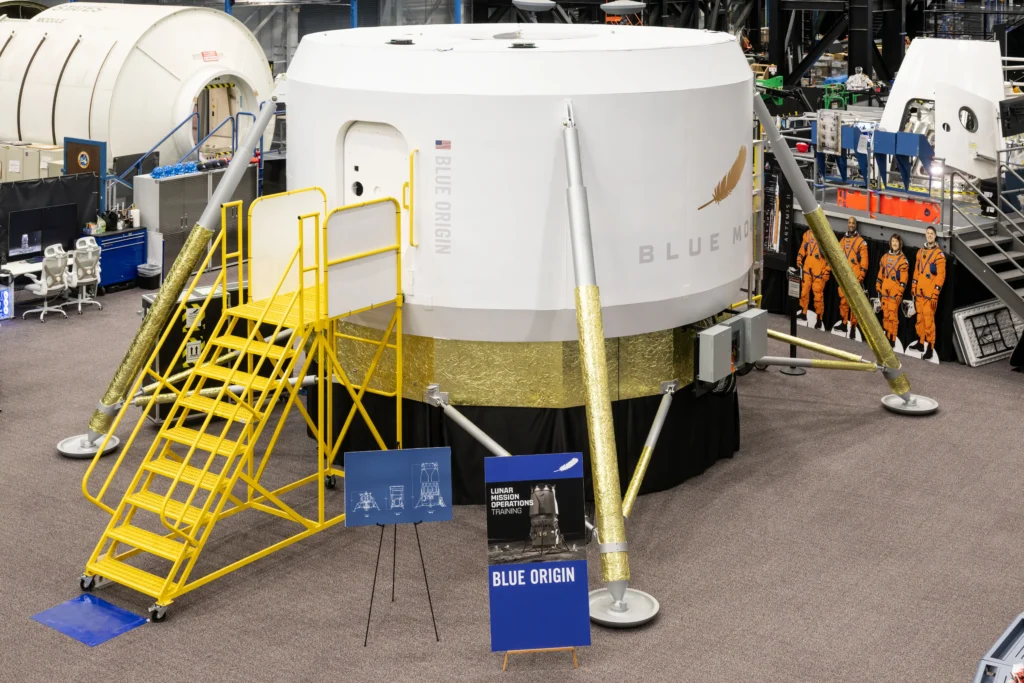
After years of delays, testing setbacks, and growing competition in the private space race, NASA is finally moving deeper into the next stage of its ambitious return-to-the-moon program. The agency has now started preparing astronauts and mission teams using a full-scale prototype of Blue Origin’s upcoming lunar lander cabin, a major step toward its long-term Artemis plans that aim to put humans back on the lunar surface later this decade.
The newly revealed training mock-up has arrived at NASA’s Johnson Space Center and represents the crew section of Blue Origin’s massive Mark 2 moon lander. Even though this version is only a prototype and not a functioning spacecraft, it gives astronauts and engineers their first realistic opportunity to physically interact with the environment they may eventually use during future moon missions. NASA confirmed that teams will now begin a long series of simulated exercises involving communication drills, suit testing, mission coordination, docking procedures, and practice moonwalk preparations.
What makes this development important is the scale of the actual spacecraft itself. The prototype cabin alone reportedly stands around 15 feet tall, but the fully integrated lunar lander is expected to reach nearly 52 feet in height once completed. That would make it one of the largest human landing systems ever developed for lunar exploration. The structure is designed not only to transport astronauts safely to the moon’s surface but also to support extended operations once crews arrive there.
The training comes shortly after the momentum generated by the Artemis II mission, which marked another critical stage in NASA’s effort to rebuild human deep-space capability. While Artemis II focused on sending astronauts around the moon rather than landing on it, the mission helped restore confidence that the broader Artemis timeline may still remain achievable despite years of technical challenges and schedule changes. NASA is currently targeting 2027 for Artemis III, the mission expected to test docking operations and potentially prepare the path toward a future moon landing.
For now, NASA is relying heavily on private aerospace companies to make that vision possible. Alongside Blue Origin, SpaceX is also developing a lunar landing system for the Artemis program. However, neither company has successfully demonstrated a crewed moon landing yet, and recent test missions across the industry have shown just how difficult lunar operations still are, even more than fifty years after the Apollo era.
Blue Origin’s uncrewed version of the spacecraft, known as Endurance or MK1, is currently undergoing environmental testing inside NASA’s thermal vacuum chambers. Those facilities are designed to recreate the harsh conditions of space, including extreme temperatures and near-total vacuum environments. The company plans to launch its first robotic lunar mission later this year, which will reportedly carry scientific payloads to the moon before any astronauts eventually step onboard future versions.
At the same time, SpaceX continues developing its lunar-adapted Starship system, another centerpiece of NASA’s Artemis strategy. The competition between the two companies has quietly become one of the most important modern space races because whichever system proves itself first could shape how future lunar exploration missions are conducted. NASA appears to be keeping both options active for now, partly to avoid depending entirely on a single provider.
The Artemis program itself carries enormous importance beyond just symbolic moon landings. NASA hopes the missions will help establish long-term lunar infrastructure, support scientific exploration around the moon’s south pole, and eventually serve as preparation for future human missions to Mars. Unlike the short Apollo visits from the 1960s and 70s, Artemis is being designed as a more sustainable and repeated presence on the moon.
Still, major technical hurdles remain. Landing massive spacecraft safely on the lunar surface is incredibly difficult because of the moon’s rough terrain, lack of atmosphere, and harsh environmental conditions. Several recent commercial lunar missions from different companies have struggled with navigation issues, unstable landings, or partial mission failures. That reality is why NASA’s current training phase matters so much — every system must be tested extensively before astronauts can safely attempt a return.
For now, the arrival of Blue Origin’s lander prototype at Johnson Space Center may not look as dramatic as an actual rocket launch, but inside the Artemis program it represents another important sign that NASA’s next moon era is slowly becoming more real.