There’s something sitting in the far corner of the universe that has scientists genuinely losing sleep. Not a new planet, not a dying star — a black hole. One that, by every rule astronomers thought they understood, simply should not be there. NASA’s James Webb Space Telescope recently confirmed something so strange and so unsettling that researchers are calling it a full-on paradigm shift in how we understand the cosmos. And honestly? That’s not even an exaggeration this time.
The object at the center of all this chaos is called Abell2744-QSO1. Rolls off the tongue, doesn’t it. It belongs to a bizarre little family of ancient cosmic objects that scientists have been casually calling “Little Red Dots” — which sounds adorable until you realise these things are tearing apart everything we thought we knew about how the universe was built. JWST first spotted these Little Red Dots back in 2022, and ever since, astronomers have been picking at them like a scab they can’t leave alone. Now they finally got a proper look inside one, and what they found was not at all what anyone expected.
The Numbers That Made Scientists Go Quiet
Using JWST’s Near Infrared Spectrograph — a tool so precise it can measure gas spinning around an object 13 billion light years away — researchers from the University of Cambridge tracked the movement of gas swirling around Abell2744-QSO1. That data let them calculate the black hole’s mass with a level of accuracy that was never possible before this telescope came along. The result came back at roughly 50 million times the mass of our Sun. That’s already a staggering number, but the real jaw-dropper isn’t the size — it’s the timing. This black hole was already fully formed just 700 million years after the Big Bang. For context, the universe is about 13.8 billion years old. So we’re talking about something ancient beyond imagination, sitting in the early universe like it owned the place before the place even existed properly.
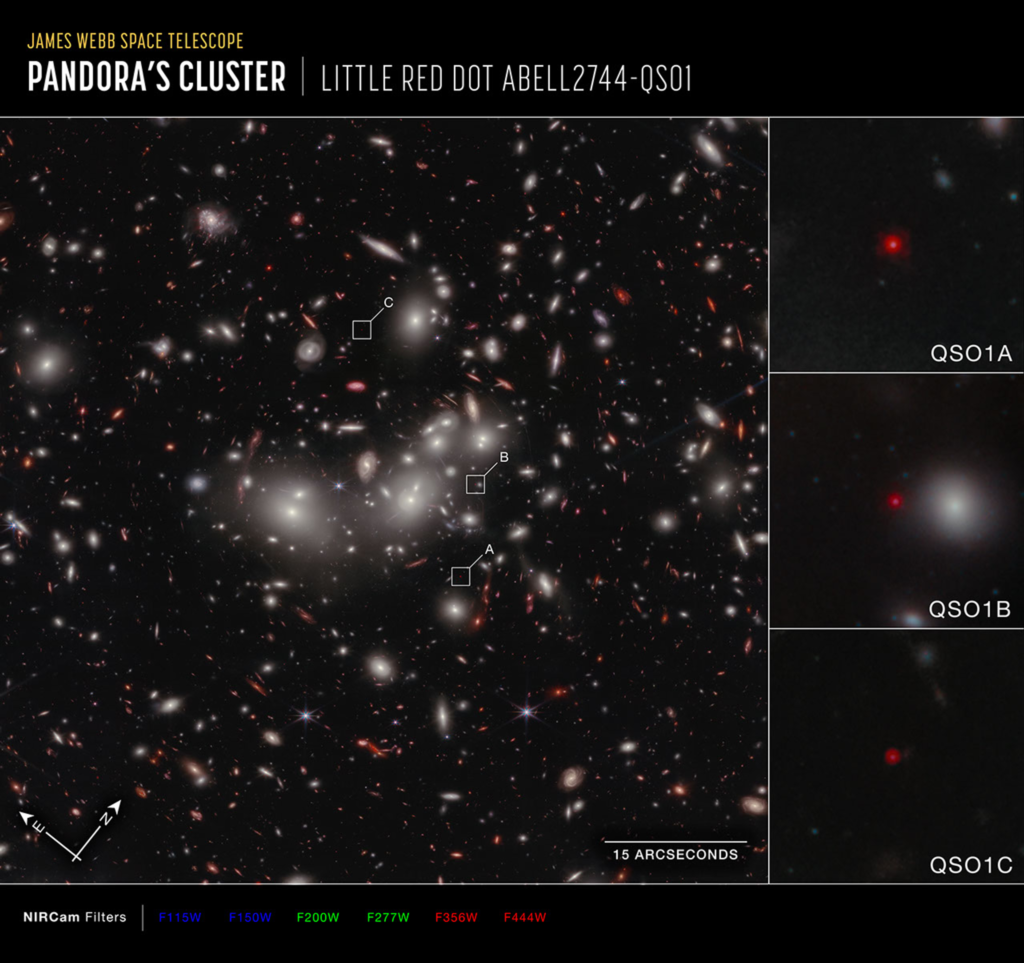
What really pushed researchers over the edge was the ratio. In galaxies like our Milky Way, the central black hole accounts for a tiny, almost negligible fraction of the galaxy’s total mass. In Abell2744-QSO1, the black hole makes up nearly two-thirds of the entire galaxy’s mass. Two-thirds. That’s not a black hole living inside a galaxy — that’s a black hole wearing a galaxy like a loose jacket. The host galaxy surrounding it is so underdeveloped compared to the black hole that scientists had to seriously reconsider which one came first.
The Question That Changes Everything
Here’s the thing about black holes and galaxies — scientists always assumed they grew together. Like two friends who started at the same time, pushed each other along, and ended up roughly balanced. The black hole feeds off the galaxy’s gas and dust, the galaxy shapes around the black hole’s gravity, and together they evolve into what we see in the universe today. That was the accepted model. Comfortable, logical, and apparently completely wrong — at least in some cases.
Roberto Maiolino of the University of Cambridge didn’t hold back when describing what JWST just uncovered. He called it a paradigm shift and a total revisiting of classical scenarios of how black holes form and grow. That kind of language doesn’t come from scientists casually. When a researcher uses words like “total revisiting,” it means the textbooks are about to get edited. Abell2744-QSO1 appears to have formed before its galaxy — the black hole came first, and the galaxy slowly built up around it later. That sequence was considered essentially impossible under previous models, and now here it is, staring back at us through a telescope.
And this isn’t an isolated freak incident either. In recent months JWST has spotted two other early-universe galaxies where the central black holes are massively oversized compared to their hosts — both seen when the universe was just around 800 million years old. The pattern is becoming harder to dismiss as coincidence. Something was producing enormous black holes in the very early universe at a rate and scale that no existing theory fully accounts for.
Born Big or Something Weirder?
So how does a black hole this massive exist this early? Scientists are throwing out two main ideas right now, and neither of them is exactly comfortable. The first is that this black hole was simply “born big” — that it didn’t slowly grow by swallowing material over billions of years, but instead collapsed directly from a massive cloud of primordial gas shortly after the Big Bang. No star phase, no gradual process — just instant heavyweight. The second possibility is even more unsettling: that there’s some mechanism operating in the early universe that we haven’t discovered yet, something that produced these colossal objects in ways that fall completely outside current physics models.
There’s also a third whisper floating around in the research community — that Abell2744-QSO1 could be one of the first real, observable candidates for a primordial black hole. These are theoretical objects proposed to have formed not from collapsing stars but from density fluctuations in the universe’s very first moments, right at the birth of everything. They’ve been theorised for decades but never convincingly confirmed. If JWST has just handed us the first real one, that changes the game entirely — not just for black hole physics but for our understanding of dark matter and the structure of the early universe.
What Happens Next
Further observations with JWST are already being planned, and future telescopes will dig even deeper into objects like Abell2744-QSO1 to figure out what exactly is going on. The Little Red Dots as a group remain deeply mysterious — they were remarkably common in the infant universe but seem to vanish around 1.5 billion years after the Big Bang, as if something shut them off. Understanding why could unlock a major missing chapter in cosmic history. For now, all we really know is that the universe is considerably stranger and more complicated than any model we’ve built for it — and JWST keeps proving that, one impossible discovery at a time.