The trade truce between Washington and Beijing may still be technically intact, but fresh friction is clearly brewing.
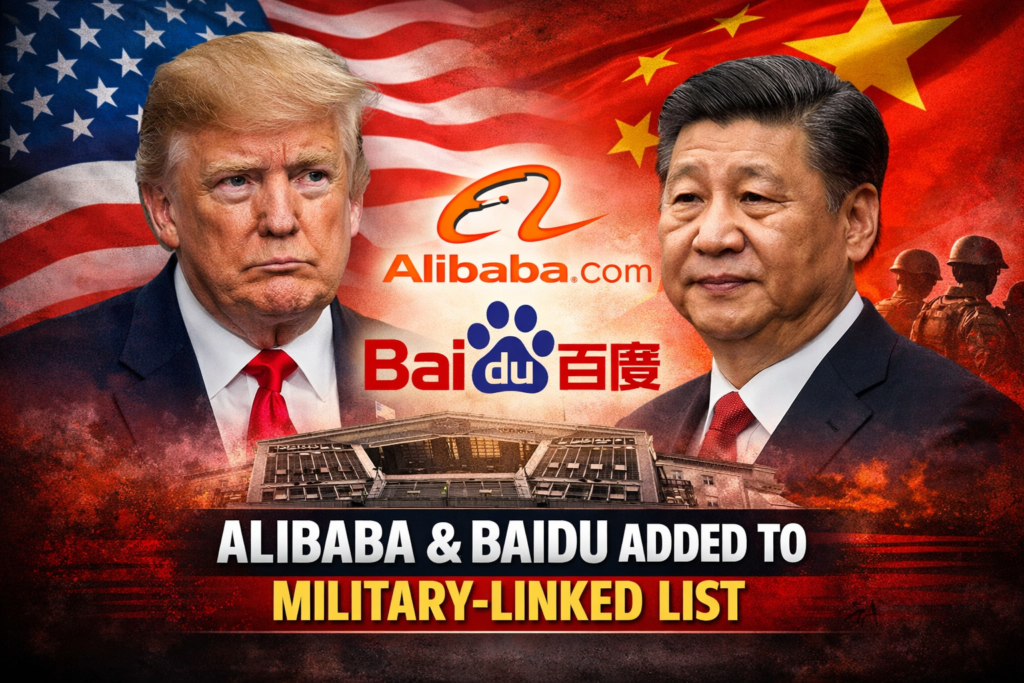
The U.S. administration has added several major Chinese companies — including tech giants Alibaba Group and Baidu — to the Pentagon’s so-called “1260H list,” which identifies firms allegedly linked to China’s military.
The move comes ahead of a potentially significant meeting between U.S. President Donald Trump and Chinese President Xi Jinping, adding fresh complexity to already delicate diplomatic ties.
What Is the 1260H List?
The Pentagon’s 1260H list does not immediately impose sanctions. However, under new U.S. legislation, government departments — including the Department of Defense — will gradually be barred from contracting with or procuring goods and services from companies named on the list.
In other words, while this isn’t an outright ban, it sends a strong signal about Washington’s security concerns.
Beyond formal restrictions, inclusion on the list often carries reputational impact. It signals to defense contractors and suppliers that the U.S. military views these firms as connected to China’s military-civil fusion strategy.
Some previously listed companies have even taken legal action to challenge their designation.
Who Was Added — And Who Was Removed?
Alongside Alibaba and Baidu, the updated list includes:
- BYD, one of the world’s largest EV makers
- WuXi AppTec, a global biotech services firm
- RoboSense Technology, known for AI-driven robotics systems
At the same time, memory chip maker Yangtze Memory Technologies (YMTC) was removed from the list. Other firms previously included were also dropped in the latest update.
The Pentagon has not publicly detailed the specific reasons for each inclusion or removal.
Corporate Pushback
Alibaba responded swiftly, stating there is “no basis” for its inclusion and insisting it is neither a military company nor part of any military-civil fusion strategy. The company has indicated it may pursue legal remedies.
Similar responses have come in the past from other firms. When Tencent Holdings was previously added to the list, it said the designation would not impact operations and sought reconsideration. Battery giant CATL also denied any military involvement when named earlier.
A Sensitive Diplomatic Moment
The timing is notable.
In October, Trump and Xi reached a temporary trade truce aimed at easing economic tensions. Updating the list now risks aggravating Beijing just as both sides are trying to stabilise relations.
Meanwhile, U.S. lawmakers have been pushing for an even broader sweep. In December, some members of Congress urged Defense Secretary Pete Hegseth to consider adding more Chinese tech firms, including AI startup DeepSeek, smartphone maker Xiaomi, and display manufacturer BOE Technology.
The Pentagon’s latest move suggests Washington is continuing to tighten scrutiny over Chinese firms with advanced technology capabilities — particularly in AI, semiconductors, biotech, and electric vehicles.
The Bigger Picture
This isn’t just about two tech companies.
It’s part of a larger geopolitical shift where economic competition, national security, and technology leadership are increasingly intertwined. The lines between commercial innovation and strategic capability are blurrier than ever — and governments are reacting accordingly.
For Beijing, the updated list may be viewed as a pressure tactic. For Washington, it’s framed as a precautionary security measure.
Final Words
The addition of Alibaba and Baidu to the Pentagon’s military-linked list doesn’t immediately change global markets overnight — but it does deepen the strategic divide between the U.S. and China.
With high-level talks on the horizon, the question now is whether this move is a negotiating lever… or the start of another escalation cycle.
Either way, the tech cold war narrative just got another chapter.