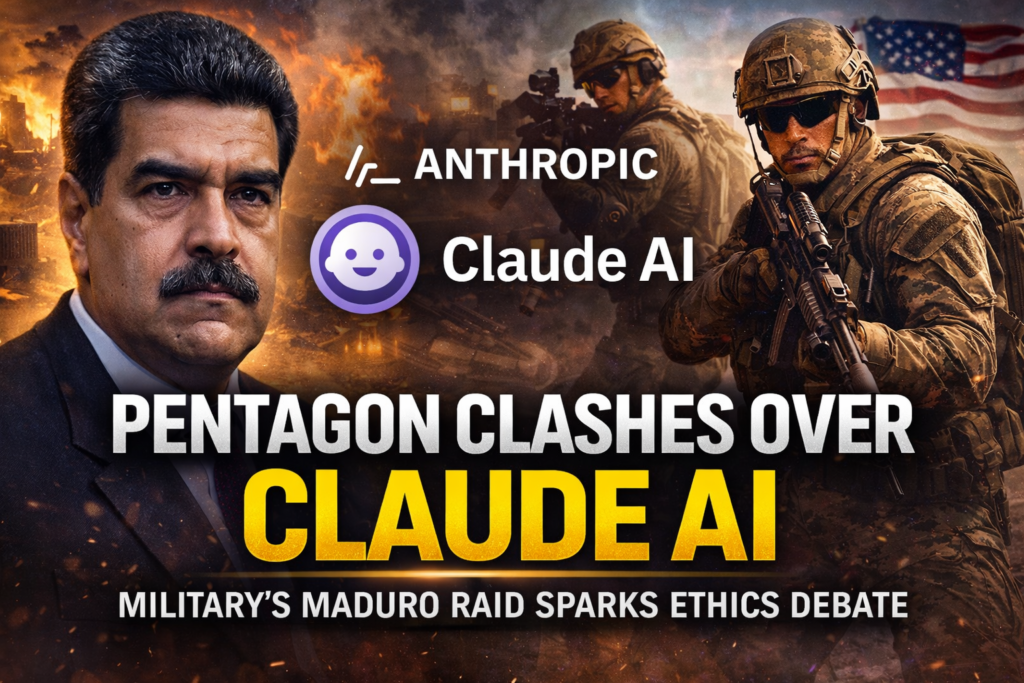
In a dramatic twist in the evolving battle over how artificial intelligence should be used in warfare, the U.S. military reportedly relied on Anthropic’s AI chatbot Claude in a classified operation that helped capture former Venezuelan President Nicolás Maduro last month, even as the company and the Pentagon clash over the technology’s role in defense.
🤖 Claude’s Unexpected Role in a High-Profile Raid
According to a Wall Street Journal report, U.S. forces accessed Anthropic’s AI model Claude via a partnership with data analytics firm Palantir Technologies, whose tools are widely integrated into U.S. Defense Department and federal law enforcement systems. Claude, best known for its natural language processing and analytical capabilities, was reportedly used during the operation that led to Maduro’s capture — a mission that involved airstrikes in Caracas and the subsequent extradition of Maduro to face drug-trafficking charges in the United States.
Anthropic declined to confirm Claude’s specific use in the mission, stating only that “any use of Claude — whether in the private sector or across government — is required to comply with our Usage Policies,” which prohibit using the AI to facilitate violence, assist in weapon design, or perform surveillance. The Pentagon and Palantir also did not provide comments on the matter.
⚠️ A Contract on the Line
This revelation comes at a tense moment in U.S. defense tech policy. Officials have revealed that the Pentagon and Anthropic are at an impasse over a contract worth up to $200 million, focused on the broader deployment of AI tools in military contexts. The core of the dispute lies in how Claude — and similar models — should be permitted to function in battlefield and classified settings.
Anthropic’s CEO Dario Amodei has publicly drawn firm lines around AI’s role in national defense, arguing that while AI should support democratic defense efforts, it should not be used in autonomous weapons targeting or enable mass surveillance — concerns that reflect the company’s broader safety-first ethos. The Pentagon, however, backed by a January defense memo, has signaled it wants the flexibility to deploy commercial AI tools more liberally in national security operations, so long as usage complies with U.S. law.
🇺🇸 AI Usage & Ethical Tensions
Anthropic is currently the only major AI developer whose models are available in classified defense networks through third parties — but even then, deployments remain subject to its internal usage policies. Other AI firms, including OpenAI and Google, have recently agreed to provide less restricted versions of their models for unclassified Pentagon use. OpenAI’s specialized ChatGPT, for instance, is already deployed on a secure Pentagon network used by millions of Defense Department personnel.
The clash highlights a broader debate across tech and national security circles: how to harness AI’s strategic benefits without undermining ethical guardrails or relinquishing human oversight over critical decisions. The potential for AI to misinterpret data, hallucinate details, or be drawn into autonomous systems underscores just how complex that balance really is.
🪖 What This Means Going Forward
The use of Claude in the Maduro operation — whether direct or indirect — illustrates how commercial AI tools are no longer confined to labs or cloud dashboards. They are intersecting with real-world strategic missions, raising new questions about transparency, control, and accountability.
How the Pentagon and AI companies ultimately resolve their differences could set the tone for the next era of military technology — and redefine the ethical boundaries for AI in warfare.
Final Words
AI is no longer just a buzzword in military strategy — it’s genuinely shaping missions. But as Claude’s involvement in the Maduro raid shows, the question isn’t just what AI can do — it’s how far it should go.
Balancing innovation with responsibility is no longer theoretical. It’s now central to national security itself.