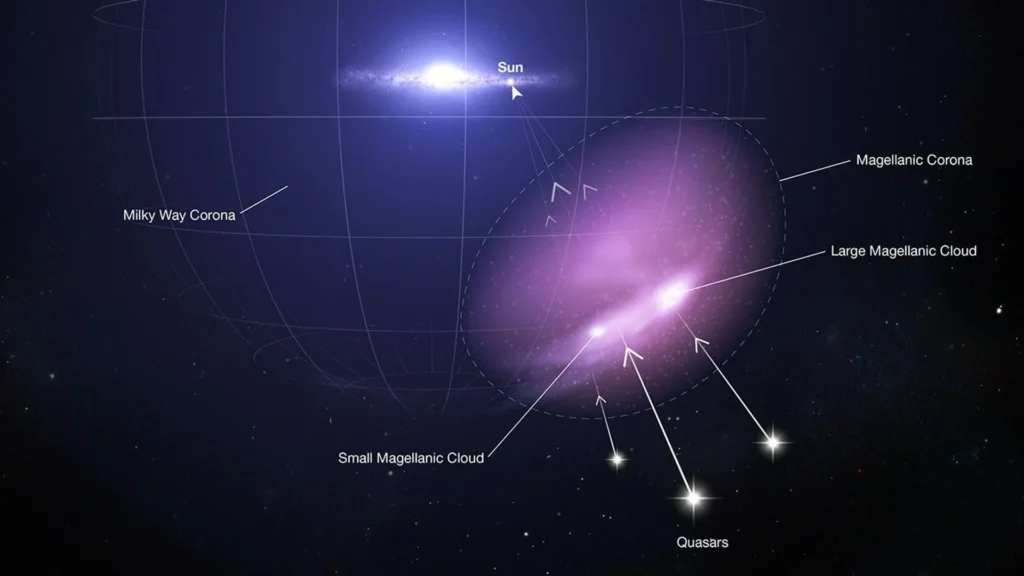
For something orbiting our own galaxy, the Large Magellanic Cloud has been surprisingly mysterious. Astronomers have been arguing for years over a simple but massive question — is this galaxy passing by the Milky Way for the first time, or has it already been here before? That answer actually matters a lot, because a galaxy this big doesn’t just pass quietly. It pulls, disturbs, and reshapes everything around it.
A new study led by researchers including Scott Lucchini and Andrew J. Fox is now leaning strongly toward one side. Their simulations suggest that this is the first time the LMC is interacting closely with the Milky Way. If that’s true, it changes how scientists understand the recent evolution of our galaxy, especially the structure of its outer halo and gas environment.
The debate itself didn’t come out of nowhere. For a long time, scientists used gravitational models — basically tracking how stars move — to estimate the LMC’s orbit. But in 2024, physicist Eugene Vasiliev introduced a bold idea. He suggested the LMC may have passed by the Milky Way once already, billions of years ago, based on how dark matter might behave in the galaxy’s halo. That theory reopened everything and suddenly, there were two competing timelines.
Lucchini’s team first tried to solve it by tracking hypervelocity stars — stars that were flung out at extreme speeds, possibly by the LMC’s central black hole. But that didn’t help much. The data could fit both scenarios, first pass or second pass. So instead of focusing only on stars, they turned to something less obvious — gas.
Using advanced simulation tools like GIZMO, the researchers modeled not just stars and dark matter, but also the gas surrounding both galaxies. Then they compared their simulated data with real observations, specifically looking at how certain elements like carbon and hydrogen absorb light from distant quasars. That might sound technical, but it’s actually one of the best ways to “see” invisible gas in space.
And this is where things got interesting. The simulation that assumed a first-time encounter matched the real data much better. In contrast, the second-pass scenario didn’t fit properly — especially when it came to the size of the LMC’s gas halo, or “corona.” If the galaxy had already passed through the Milky Way before, that corona should have been much smaller due to interactions with surrounding gas. But observations suggest otherwise.
Still, it’s not a clean victory for one side. The model had some limitations. For example, it didn’t include the Small Magellanic Cloud, which actually plays a big role in shaping the gas streams connected to the LMC. The simulation also simplified the Milky Way’s gas halo, which in reality is far more complex. These shortcuts were necessary to make the calculations possible, but they do leave some room for doubt.
And just when things seemed to lean toward the “first pass” idea, another study complicated things again. Observations using the Subaru telescope found tidal debris — basically leftover stellar material — in the Milky Way’s halo that seems to support the second-pass theory. So now, instead of one clear answer, scientists are back to weighing two strong possibilities.
That’s really the nature of astronomy at this level. Even with advanced simulations and powerful telescopes, we’re still piecing together events that happened billions of years ago. Upcoming missions, like NASA’s Aspera project, might finally give clearer answers by mapping the gas structures around these galaxies in more detail.
For now, though, the question remains open. The Large Magellanic Cloud is still circling us, still influencing our galaxy, and still holding onto a story we haven’t fully decoded yet.