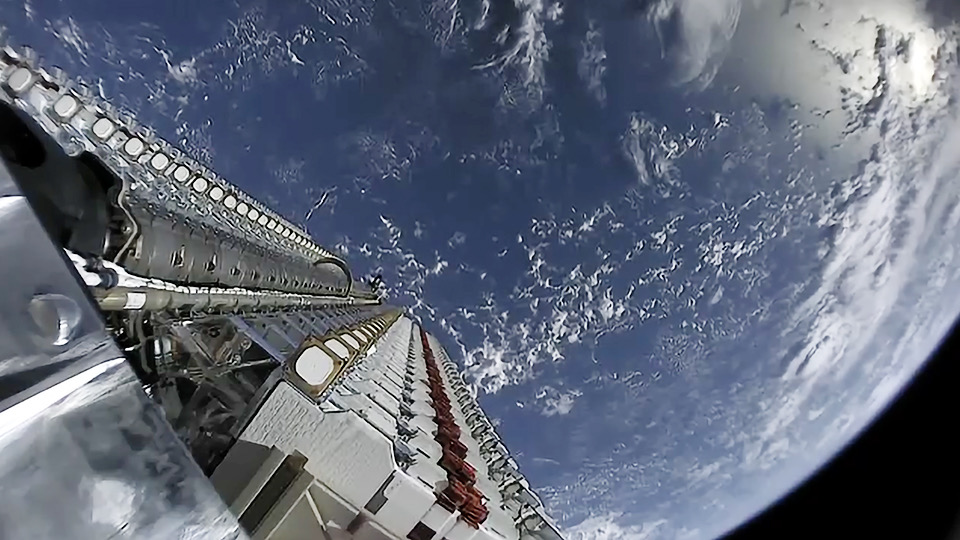
SpaceX continued expanding its massive Starlink internet network this week after successfully launching another batch of 24 satellites into orbit from California. The mission took place late Tuesday night from Vandenberg Space Force Base aboard a Falcon 9 rocket, marking yet another step in the company’s relentless effort to build one of the largest satellite constellations ever created.
The launch lifted off from Space Launch Complex 4 East at 10:46 p.m. EDT carrying Starlink Group 17-42 satellites into low-Earth orbit. According to mission details, the satellites reached their provisional orbit within around nine minutes after liftoff before being fully deployed less than an hour later. For SpaceX, launches like this have now become so routine that the company sometimes conducts multiple missions within the same week without much slowdown.
One of the biggest talking points from the mission involved the rocket booster itself. The Falcon 9 first-stage booster used for the flight, identified as B1103, had previously flown only once before. After separating from the upper stage during ascent, the booster performed its reentry burn and later landed successfully on SpaceX’s drone ship “Of Course I Still Love You,” stationed in the Pacific Ocean. The landing once again highlighted the company’s reusable rocket strategy, which remains one of the biggest reasons SpaceX has managed to reduce launch costs so aggressively compared to traditional aerospace competitors.
The ability to recover and reuse boosters has completely changed the economics of modern rocket launches. Instead of throwing away multi-million-dollar rocket hardware after every mission, SpaceX refurbishes boosters for repeated flights. That system has allowed the company to rapidly scale Starlink deployments while also supporting commercial launches, government missions, and crewed spaceflights at the same time.
Starlink Network Quietly Becoming One of the Largest Systems in Space
With this latest deployment, the total number of active Starlink satellites orbiting Earth is now approaching 10,500, according to satellite tracker Jonathan McDowell. That number alone is staggering because it means SpaceX now operates more satellites than many countries and companies combined. The constellation continues growing almost every month as SpaceX races to strengthen global internet coverage and improve network capacity.
Unlike traditional communications satellites positioned extremely far from Earth in geostationary orbit, Starlink satellites operate much closer to the planet in low-Earth orbit. Most of them travel between roughly 340 and 570 kilometers above Earth’s surface. That shorter distance is extremely important because it significantly reduces internet latency, allowing smoother video calls, gaming, livestreaming, and faster general browsing speeds even in remote areas where broadband infrastructure barely exists.
SpaceX claims the low-latency system can deliver response times under 27 milliseconds in certain conditions, which is dramatically lower than older satellite internet systems. That performance advantage is one reason Starlink has expanded rapidly across rural regions, maritime operations, airlines, disaster zones, and even military communication networks over the last few years.
At the same time though, the ever-growing constellation continues sparking concerns among astronomers and environmental researchers. Critics have repeatedly warned that thousands of satellites crowding low-Earth orbit could increase collision risks and worsen space debris problems over time. Astronomers have also complained about satellite brightness interfering with deep-space observations and telescope imaging.
SpaceX Shows No Signs of Slowing Down
Despite those concerns, SpaceX’s launch pace only seems to be accelerating further. The company has turned Falcon 9 launches into almost assembly-line operations at this point, with missions happening so frequently that they no longer feel rare events in the aerospace industry. Every successful Starlink mission strengthens SpaceX’s long-term strategy of turning satellite internet into a massive global business capable of funding future projects like Mars missions and deep-space exploration.
The latest mission also reflects how dominant Falcon 9 has become in the commercial launch market. Very few rockets anywhere in the world currently match its combination of launch frequency, reusability, and reliability. While competitors continue developing reusable systems of their own, SpaceX already operates at a scale most aerospace companies are still years away from reaching.
For now, the company’s giant internet constellation keeps growing steadily above Earth, one launch at a time. And with Starlink now nearing 10,500 active satellites, the scale of what SpaceX has built is honestly starting to feel almost difficult to comprehend.