Something unusual is happening far out in the solar system, and it’s not just about icy planets anymore. Uranus — often ignored compared to its flashier neighbor Saturn — is suddenly back in focus after scientists uncovered surprising new details about its outer rings. What looked like faint, distant structures are now turning into clues about hidden moons, organic material, and a much more complex system than anyone expected earlier.
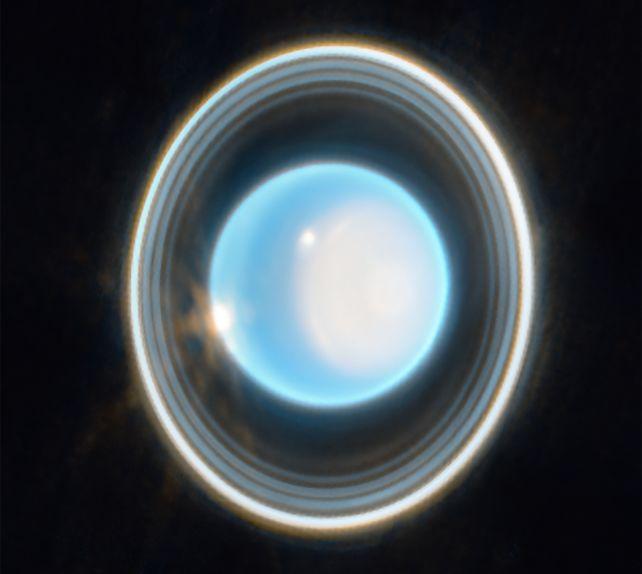
For years, Uranus has been known as that odd planet spinning sideways in deep space, cold and quiet with a ring system that never really got the spotlight. Its rings were only discovered in 1977, and even today they don’t shine as brightly as Saturn’s. But now, new observations are slowly changing that perception. Researchers studying the outermost rings — known as the μ (mu) and ν (nu) rings — are finding that these distant bands behave very differently from each other, almost like they belong to two separate stories unfolding at once.
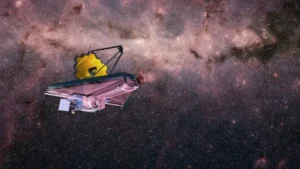
A recent study published in Journal of Geophysical Research: Planets brings together data from some of the most powerful observatories we have, including the James Webb Space Telescope, Hubble Space Telescope, and the W. M. Keck Observatory. Led by scientist Imke de Pater, the research team created a detailed reflectance spectrum of both rings — basically a way to understand what they’re made of by studying how they reflect light. And the results weren’t what many expected.
The μ ring, which appears slightly bluish, seems to be made largely of water ice. Scientists believe these icy particles are constantly being knocked off a small nearby moon called Mab due to tiny space impacts. It’s a dynamic system — not something static — meaning the ring is constantly being replenished in a way. That gives it a fresh, icy look compared to other parts of the system.
But the ν ring tells a completely different story. Instead of ice, it shows a reddish tone and contains a mix of minerals along with around 10–15% carbon-based organic material. That’s where things start getting interesting. The presence of these organics suggests that something — or rather, multiple small things — might be shaping the ring from within. Scientists believe there could be tiny, unseen moonlets orbiting in that region, too small for current telescopes to clearly detect, yet still powerful enough to influence the dust and structure of the ring.
This idea of hidden objects isn’t just speculation anymore. In 2025, the James Webb Space Telescope identified a tiny new Uranian moon named S/2025 U1, measuring just about 10 kilometers across. That discovery has strengthened the theory that there may be many more such bodies quietly orbiting Uranus, shaping its rings in ways we’re only beginning to understand. It’s like finding one missing puzzle piece and realizing there could be dozens more still out there.
At the same time, some mysteries remain unresolved. One big question scientists are still trying to answer is why Mab appears so icy while other nearby moons are more rocky in nature. That contrast doesn’t fully make sense yet, and it hints that Uranus may have had a very different formation history compared to other planets. These differences are exactly why researchers are now pushing harder for a dedicated mission to Uranus — something that could provide close-up data instead of relying only on distant observations.
What’s becoming clear is that Uranus is no longer just a quiet, distant planet sitting on the edge of the solar system. Its rings are active, evolving, and possibly hiding entire populations of tiny moons that we haven’t even seen yet. And if these early findings are anything to go by, we might just be scratching the surface of a much bigger cosmic story waiting to unfold.