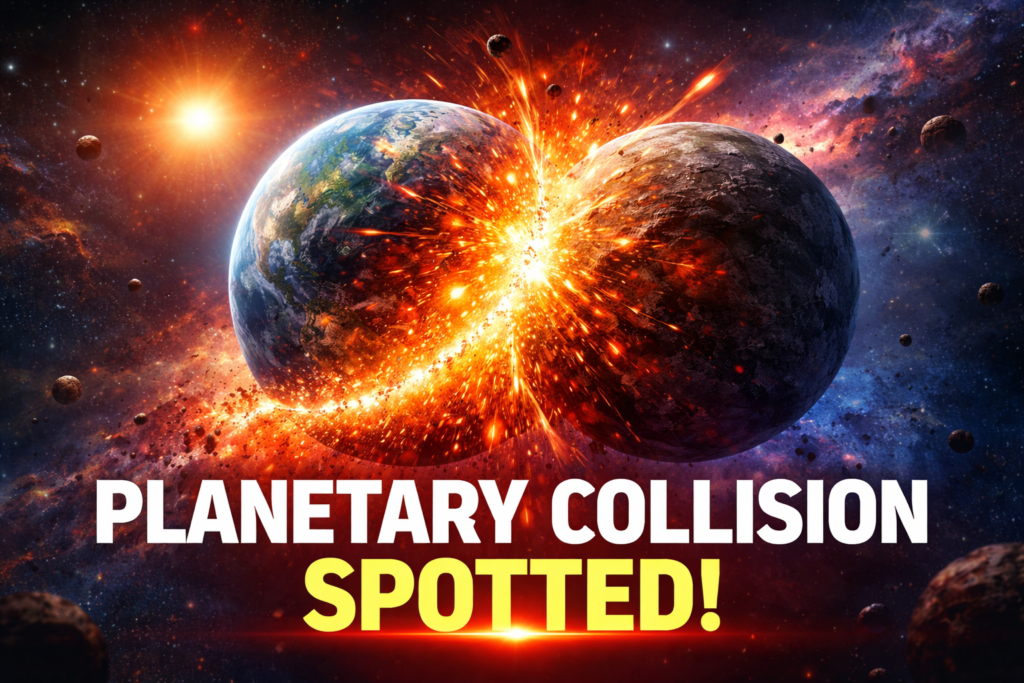
In a discovery that feels straight out of a cosmic disaster movie, astronomers have detected signs that two massive planets may have violently collided around a distant star. The rare event was observed around a Sun-like star called Gaia20ehk, located roughly 11,000 light-years from Earth, offering scientists an unusual glimpse into how planetary systems can evolve through catastrophic impacts.
Researchers believe the observation captured the aftermath of a gigantic planetary smash-up — something that scientists have long theorized happens frequently in young star systems but is rarely seen in real time.
Strange Changes in the Star’s Light
The mystery began when astronomers noticed unusual changes in the brightness of Gaia20ehk. For years, the star appeared stable, but in 2016 it began showing small dimming events that hinted something unusual was happening in its system.
By 2021, the star’s brightness patterns became dramatically irregular. The light curve — the measurement astronomers use to track how a star’s brightness changes over time — started fluctuating in unpredictable ways.
That strange behavior prompted scientists to look closer using infrared observations, which detect heat rather than visible light.
What they found was striking.
While the star’s visible light appeared to dim and flicker, infrared radiation from the system suddenly surged, suggesting that something extremely hot was orbiting the star.
A Massive Cloud of Superheated Debris
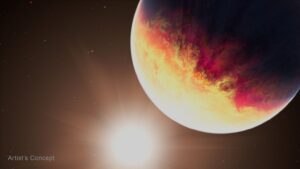
According to astronomers, the most likely explanation is a huge cloud of debris created by a planetary collision.
When two planets crash into each other at cosmic speeds, the impact releases enormous energy. The collision shatters both bodies, producing a massive cloud of rock, dust, and molten material that becomes intensely hot.
Scientists believe this debris cloud is now orbiting Gaia20ehk, temporarily blocking some of the star’s visible light while glowing brightly in infrared wavelengths.
Astronomer Anastasios Tzanidakis, one of the researchers studying the phenomenon, explained that the sudden infrared spike alongside the dimming visible light strongly suggests the presence of extremely hot material surrounding the star.
Other possibilities — such as comet fragments or asteroid dust — cannot produce such intense heating, making a planet-on-planet collision the most convincing explanation.
What This Means for Planet Formation
Violent impacts like this were once common in the early days of planetary systems. Our own Solar System likely experienced similar collisions billions of years ago.
In fact, scientists believe Earth’s Moon formed after a Mars-sized object smashed into the young Earth, ejecting debris that eventually coalesced into the Moon.
The debris cloud around Gaia20ehk may follow a similar path.
Currently, astronomers estimate the material is orbiting the star at roughly one astronomical unit, about the same distance between Earth and the Sun. Over millions of years, the debris could gradually cool and clump together, potentially forming new planetary bodies or moons.
A Rare Glimpse Into Cosmic Violence
Observing such events directly is extremely rare. While planetary collisions are believed to occur in many star systems, astronomers usually see the results long after the dust settles.
Catching the immediate aftermath — when the debris is still hot and chaotic — is unusual.
Scientists expect that future surveys, especially those conducted by the Vera Rubin Observatory’s Legacy Survey of Space and Time, will uncover more events like this. These discoveries could help astronomers understand how frequently Earth-like planets and moon systems form across the galaxy.
Final Words
The possible planetary crash around Gaia20ehk offers a dramatic reminder that the universe is still shaping itself in powerful ways. While catastrophic collisions may sound destructive, they are also a crucial part of how planetary systems evolve.
Events like this may have played a role in shaping our own Solar System — and may even be responsible for creating the conditions that eventually made life on Earth possible.
According to a report by Reuters, astronomers believe continued observations could reveal even more clues about how planets and moons emerge from these cosmic smash-ups.