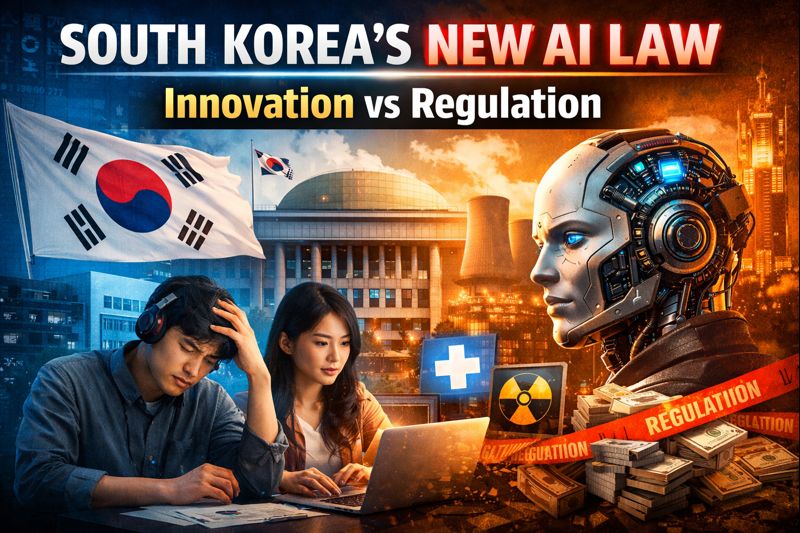
South Korea has officially stepped into uncharted territory. On Thursday, the country introduced what it calls the world’s first fully comprehensive law regulating artificial intelligence, aiming to tighten safety, accountability, and public trust in high-impact AI systems — while still pushing its ambition to become a global AI powerhouse.
The new framework, known as the AI Basic Act, comes into force ahead of similar regulations in Europe and immediately places South Korea at the centre of the global AI policy debate.
What the New AI Law Requires
Under the new rules, companies developing or deploying high-impact AI systems will be required to ensure human oversight in sensitive sectors. These include healthcare, nuclear safety, drinking water production, transportation, and financial services such as credit evaluation and loan screening.
Another major pillar of the law focuses on transparency. Businesses must:
- Clearly inform users in advance when products or services rely on high-impact or generative AI
- Label AI-generated content, especially when it is difficult to distinguish from real-world material
Failure to comply won’t be symbolic. Companies that fail to label generative AI outputs could face fines of up to 30 million won (around $20,400).
Faster Than Europe, Stricter Than Many Expected
One notable aspect of South Korea’s move is speed. The AI Basic Act is being enforced earlier than the EU’s AI Act, which will roll out in phases through 2027.
That said, penalties in Europe remain significantly steeper. Under EU rules, violations can result in fines ranging from 1% of global turnover for minor breaches to 7% for serious violations involving banned AI uses.
Globally, there is still no unified approach. The United States continues to favour a lighter regulatory touch to avoid slowing innovation, while China has introduced selective rules and proposed an international coordination body for AI governance.
Startups Push Back: “Why Do We Have to Be First?”
While the government has framed the law as a trust-building measure, parts of South Korea’s startup ecosystem are uneasy.
Lim Jung-wook, co-head of the Startup Alliance, said many founders are frustrated that key details of the law remain unclear. The biggest concern is vague language, which could push companies to play safe rather than experiment.
“There’s a bit of resentment — why do we have to be the first to do this?” he said, warning that fear of regulatory missteps could slow innovation.
Government Response and Grace Period
President Lee Jae Myung acknowledged those concerns during a meeting with aides, urging policymakers to strike a careful balance.
He stressed that innovation must be supported even as risks are managed, adding that institutional backing for startups and venture firms would be critical during this transition.
To ease the shift, the Ministry of Science and ICT has promised:
- A grace period of at least one year before fines are imposed
- A dedicated guidance platform and support centre for companies
- Possible extension of the grace period, depending on industry conditions at home and abroad
Officials said the framework was designed not to choke AI development, but to guide it responsibly.
Why This Matters Globally
South Korea’s decision is likely to influence how other countries approach AI governance. By moving early, the country is positioning itself not just as a tech producer, but as a rule-setter — something traditionally dominated by the EU and the U.S.
Whether this bold move accelerates trust or slows innovation will become clear over the next few years, especially as startups adapt and regulators clarify grey areas.
Final Words
South Korea’s AI Basic Act marks a defining moment in global AI regulation. It’s ambitious, fast-moving, and undeniably risky. For policymakers, it’s a bid for leadership. For startups, it’s a test of survival and flexibility. And for the world, it may be a preview of how AI governance could look in the decade ahead.