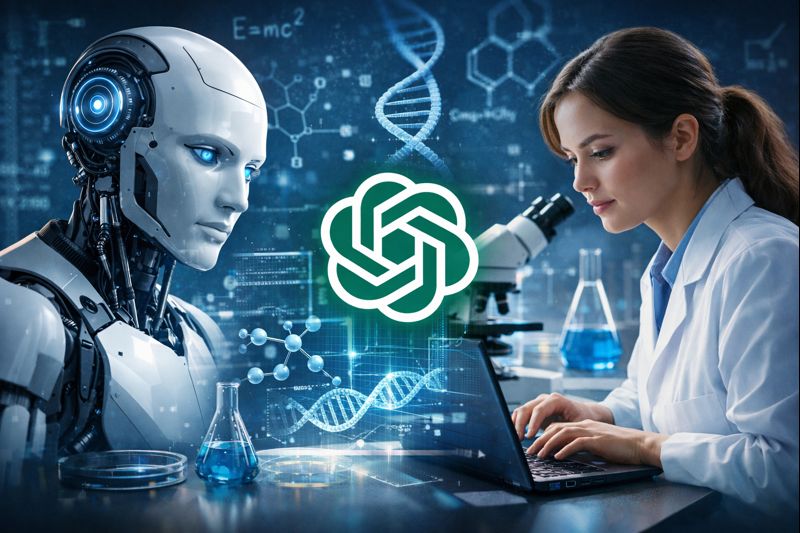
Artificial intelligence is no longer just a support tool for scientists — it’s starting to act like a collaborator. That’s the core message from OpenAI, which has outlined how AI systems like ChatGPT are increasingly being woven into everyday scientific research across disciplines such as mathematics, physics, chemistry, and biology.
In a newly released report, OpenAI argues that AI-powered tools are already reshaping how researchers think, plan, and execute their work — and that this shift is only accelerating.
AI Moves From Assistant to Collaborator
According to OpenAI, scientists are now using AI not just for surface-level tasks but as part of their core research workflow. The company says tools like ChatGPT are helping researchers synthesize vast amounts of academic literature, interpret complex datasets, plan experiments, debug code, and even explore open-ended scientific questions.
The 20-page report, shared exclusively with Axios, positions AI as a “scientific collaborator” — a system that can actively participate in the thinking process rather than simply execute instructions.
While writing and communication remain the most common use cases, OpenAI notes that more advanced applications — such as reasoning through hypotheses or assisting with calculations — are still underused, presenting a major opportunity for deeper AI integration.
Usage Numbers Point to Rapid Growth
OpenAI backed its claims with anonymised usage data that highlights a sharp rise in scientific engagement on ChatGPT.
Between January and December 2025, weekly messages related to advanced science and mathematics topics grew by around 47% year-on-year, increasing from approximately 5.7 million to nearly 8.4 million messages. By January 2026, OpenAI says around 1.3 million users per week were actively discussing advanced science and math topics on the platform.
The data suggests that millions of scientists, engineers, and mathematicians are already relying on AI to support scholarly work — even if the full potential of these systems is still being explored.
OpenAI’s Push for Smarter Science Policy
Beyond usage trends, the report also signals a broader ambition. OpenAI is advocating for expanded access to AI tools in research settings and updated science policies that recognise AI as a legitimate part of modern discovery.
This thinking aligns with the company’s OpenAI for Science initiative, which aims to connect researchers with AI systems capable of speeding up everything from literature analysis to modelling and simulation. The long-term goal, OpenAI says, is to embed AI naturally into scientific practice — reducing friction, shortening discovery cycles, and enabling breakthroughs that might otherwise take years.
“We’re Entering a New Acceleration Phase”
Commenting on the findings, Kevin Weil said the impact of AI in real research environments is becoming increasingly visible.
He noted that researchers are now using advanced reasoning systems to make progress on unresolved problems, interpret complex data more efficiently, and iterate faster in experimental settings. While he acknowledged that the technology is still in its early stages, Weil stressed that the pace of adoption and quality of output suggest science is on the verge of a significant acceleration.
Final Words
OpenAI’s latest report paints a clear picture: AI is no longer sitting on the sidelines of scientific research. With millions of researchers already engaging with tools like ChatGPT — and usage growing fast — the line between human insight and machine assistance is beginning to blur.
Whether AI truly becomes a trusted collaborator across all scientific fields will depend on how deeply it integrates into research culture. But if current trends hold, the way science is done may already be changing — faster than many expected.