Intro: A Galaxy From the Universe’s Childhood
Imagine seeing light that began its journey before Earth even existed.
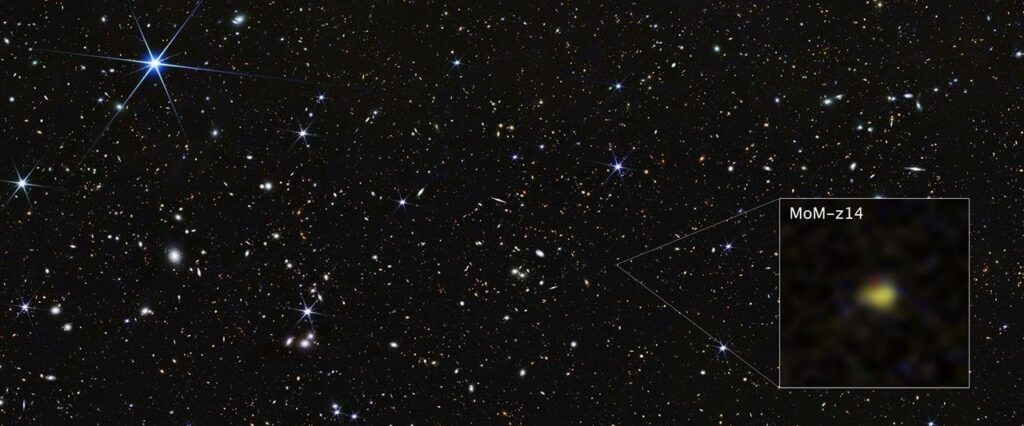
That’s exactly what astronomers have done with the discovery of MoM-z14, now considered the most distant galaxy ever observed by the NASA-led James Webb Space Telescope. The galaxy dates back to when the universe was just 280 million years old — a blink in cosmic time often called the “cosmic dawn.”
Its light has traveled nearly 13.5 billion years to reach us.
And here’s the twist: it’s not behaving the way scientists expected.
Brighter, Denser, More Mature Than It Should Be
Before Webb launched, astronomers assumed that galaxies this early in the universe would be faint, small, and chemically primitive. After all, stars need time to form, evolve, and enrich space with heavier elements.
But MoM-z14 doesn’t fit that script.
According to findings published in the Open Journal of Astrophysics following Webb data collected in April 2025, the galaxy appears compact, surprisingly bright, and chemically enriched — especially in nitrogen. High nitrogen levels suggest massive stars inside the galaxy evolved much faster than current models predict.
Even more puzzling? The surrounding region lacked the thick primordial hydrogen gas scientists expected to see in such an early era.
In short, this galaxy looks… older than it should be.
Why This Is a Big Deal
For decades, theoretical models have tried to explain how the first galaxies formed after the Big Bang. The early universe was thought to be chaotic, slow-building, and dominated by hydrogen and helium.
Webb’s infrared instruments, however, are repeatedly revealing galaxies that appear unusually developed within the universe’s first few hundred million years.
That creates tension between theory and observation.
But scientists aren’t panicking — they’re intrigued.
Every unexpected discovery is an opportunity to refine models of early cosmic evolution. If stars formed faster and galaxies assembled earlier than predicted, our understanding of cosmic timelines may need updating.
Webb Keeps Breaking Records
This isn’t the first time the James Webb Space Telescope has shocked astronomers. Since its launch, it has consistently detected bright, structured galaxies farther back in time than previously thought possible.
Instead of rare, dim objects, Webb is finding surprisingly luminous early systems — again and again.
Many researchers now believe we’re just at the beginning of a wave of record-breaking discoveries. With its powerful infrared eye, Webb can peer through cosmic dust and detect light stretched by billions of years of expansion.
And MoM-z14 may not hold the “most distant” title for long.
What Worked: Infrared Vision and Precision
Webb’s ability to observe in infrared wavelengths is the game changer here. As the universe expands, light from distant galaxies stretches into infrared frequencies. Older telescopes simply couldn’t capture these signals with the same clarity.
That precision is why discoveries like MoM-z14 are even possible.
What Didn’t: Old Models Hold Up Poorly
If galaxies were forming stars and enriching themselves this quickly, current simulations may be underestimating the speed and efficiency of early cosmic processes.
The mismatch doesn’t invalidate decades of work — but it does suggest the early universe was more complex and dynamic than we imagined.
Final Words
MoM-z14 isn’t just another distant dot in space. It’s a cosmic message from the universe’s childhood — and it’s telling us we still have a lot to learn.
With the James Webb Space Telescope continuing its mission, astronomers are bracing for more surprises. If this is what the first 280 million years looked like, the story of our universe may be far more dramatic than we ever thought.